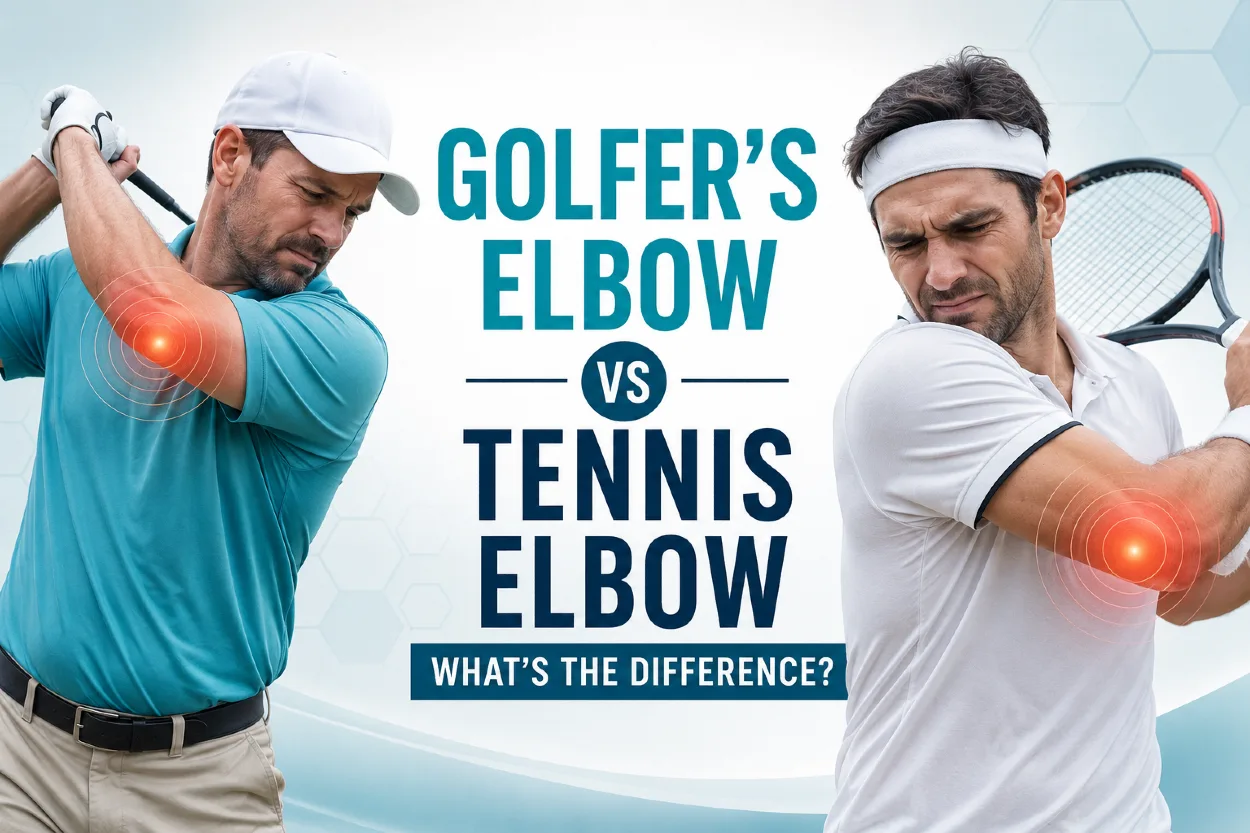
Golfer’s elbow and tennis elbow are two common causes of elbow pain, but they affect different sides of the joint and involve different groups of tendons. Golfer’s elbow, also called medial epicondylitis, causes pain on the inner side of the elbow, while tennis elbow, or lateral epicondylitis, causes pain on the outer side.
Despite their names, neither condition is limited to golfers or tennis players. Both can develop when repetitive gripping, lifting, or forearm movements place more stress on a tendon than it can adequately tolerate and recover from. Golfer’s elbow primarily affects the common flexor tendon, whereas tennis elbow usually involves the common extensor tendon.
The symptoms can sometimes feel similar, particularly when gripping or using the arm, which can make it difficult to tell the two conditions apart. However, the location of pain and the movements that reproduce symptoms usually provide important clues.
In this guide, we compare golfer’s elbow vs tennis elbow, including their symptoms, causes, affected tendons, diagnosis, treatment, and recovery. Understanding the differences can help you identify which condition may be causing your elbow pain and when medical evaluation may be appropriate.
Key Clinical Points – Golfer’s Elbow vs Tennis Elbow
- Golfer’s elbow causes pain on the inner side of the elbow and primarily affects the common flexor tendon.
- Tennis elbow causes pain on the outer side of the elbow and primarily affects the common extensor tendon.
- Both conditions are mainly tendinopathies related to repetitive tendon loading, rather than simple inflammatory disorders.
- The mechanical demands differ: golfer’s elbow is commonly aggravated by wrist flexion, forearm pronation, and gripping, while tennis elbow is associated with wrist extension, gripping, and lifting.
- Both conditions are usually treated conservatively with activity modification, pain management, and progressive tendon rehabilitation.
- Recovery can take several months, particularly in chronic cases, but most patients improve without surgery when appropriate rehabilitation and load management are followed.
Learn more: Golfers Elbow (Medial Epicondylitis): Symptoms, Causes, Diagnosis and Treatment
Learn more: Tennis Elbow (Lateral Epicondylitis): Symptoms, Causes, Diagnosis and Treatment
Key Differences: Golfer’s Elbow vs Tennis Elbow
Golfer’s elbow and tennis elbow are both overuse tendinopathies, but they affect different tendon groups and cause pain on opposite sides of the elbow. Golfer’s elbow affects the inner side, while tennis elbow affects the outer side. The table below summarizes the key differences.
| Feature | Golfer’s Elbow | Tennis Elbow |
|---|---|---|
| Medical term | Medial epicondylitis | Lateral epicondylitis |
| Pain location | Inner side of the elbow | Outer side of the elbow |
| Main tendon | Common flexor tendon | Common extensor tendon |
| Pain-provoking movements | Wrist flexion and forearm pronation | Wrist extension and gripping |
| Typical symptoms | Medial elbow pain and reduced grip strength | Lateral elbow pain and reduced grip strength |
| Common activities | Golf, throwing, climbing, manual work | Tennis, gripping, lifting, manual work |
| Nearby nerve | Ulnar nerve | Radial nerve branches |
| Most characteristic clue | Pain with resisted wrist flexion or forearm pronation | Pain with resisted wrist extension or gripping |
Golfer’s Elbow
Golfer’s elbow causes pain on the inner side of the elbow and primarily affects the common flexor tendon. Symptoms are commonly aggravated by wrist flexion, forearm pronation, and forceful gripping.
Tennis Elbow
Tennis elbow causes pain on the outer side of the elbow and primarily affects the common extensor tendon. Symptoms are commonly aggravated by wrist extension, gripping, and lifting with the wrist extended.
In simple terms: golfer’s elbow affects the tendons on the inside of the elbow, while tennis elbow affects the tendons on the outside of the elbow.
Golfer’s Elbow vs Tennis Elbow: Anatomy
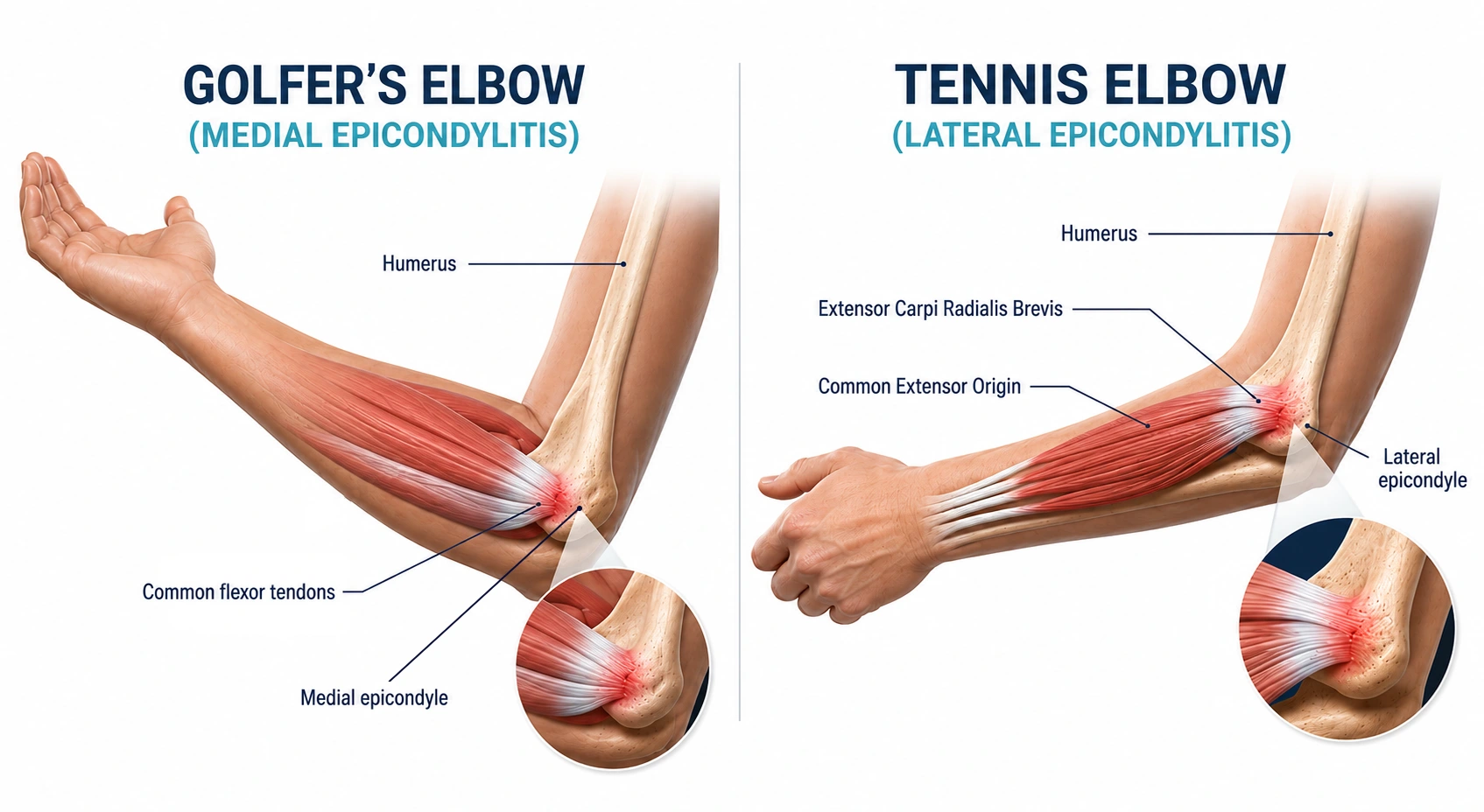
Both conditions affect the tendon attachments around the elbow, but they involve different sides of the joint and different muscle-tendon groups. Understanding the anatomy helps explain why golfer’s elbow produces medial elbow pain, while tennis elbow causes pain on the lateral side.
Golfer’s Elbow Anatomy
Golfer’s elbow primarily involves the medial epicondyle, the bony prominence on the inner side of the elbow. The common flexor tendon attaches several forearm muscles to this area. These muscles are responsible mainly for wrist and finger flexion and forearm pronation.
The main anatomical structures involved include:
- Medial epicondyle – the bony attachment site on the inner side of the elbow.
- Common flexor tendon – the main tendon affected in golfer’s elbow.
- Flexor-pronator muscle group – muscles involved in wrist flexion, finger flexion, and forearm pronation.
- Ulnar nerve – runs directly behind the medial epicondyle and can produce similar symptoms when irritated.
Tennis Elbow Anatomy
Tennis elbow primarily affects the lateral epicondyle, the bony prominence on the outer side of the elbow. The common extensor tendon attaches the wrist and finger extensor muscles to this region. The extensor carpi radialis brevis (ECRB) is particularly important in lateral epicondylitis.
The main anatomical structures include:
- Lateral epicondyle – the bony attachment site on the outer side of the elbow.
- Common extensor tendon – the primary tendon involved in tennis elbow.
- ECRB and extensor muscle group – muscles responsible mainly for wrist and finger extension.
- Radial nerve and posterior interosseous nerve – nearby neural structures that may produce symptoms resembling lateral elbow tendinopathy and are important differential diagnoses.
Golfer’s Elbow vs Tennis Elbow: Symptoms
Golfer’s Elbow Symptoms
Golfer’s elbow typically causes pain on the inner side of the elbow, around the medial epicondyle where the common flexor tendon attaches. Symptoms usually become more noticeable during activities that load the forearm flexor and pronator muscles.
Common symptoms include:
- Inner elbow pain, particularly around the medial epicondyle
- Tenderness over the medial epicondyle and common flexor tendon
- Pain when gripping objects or making a fist
- Pain during wrist flexion
- Pain with forearm pronation (turning the palm downward)
- Reduced grip strength in some patients
- Pain that may radiate down the inner forearm
Tennis Elbow Symptoms
Tennis elbow typically causes pain on the outer side of the elbow, around the lateral epicondyle where the common extensor tendon attaches. Symptoms are often aggravated by gripping, lifting, and movements that require wrist extension.
Common symptoms include:
- Outer elbow pain, particularly around the lateral epicondyle
- Tenderness over the lateral epicondyle and common extensor tendon
- Pain when gripping objects
- Pain during wrist extension
- Pain when lifting objects, especially with the palm facing downward
- Reduced grip strength
- Pain that may radiate down the outer forearm
How the Pain Feels
The easiest way to distinguish the two conditions is where the pain is located and which movements reproduce it. Golfer’s elbow causes pain on the inside of the elbow, while tennis elbow causes pain on the outside.
Both conditions can cause pain during gripping and repetitive forearm activity, and both may become more painful with increased workload. In more persistent cases, discomfort can occur even at rest or after activity. Pain may also radiate into the forearm, although the pattern differs between the two conditions.
Clinical Insight
In simple terms: if the pain is mainly on the inner side of your elbow, golfer’s elbow is more likely; if it is on the outer side, tennis elbow is more likely. However, other elbow conditions can cause similar symptoms, so persistent or unusual pain should be properly assessed.
What Causes Golfer’s Elbow and Tennis Elbow?
Both golfer’s elbow and tennis elbow develop when the mechanical load placed on a tendon exceeds its ability to adapt and recover. Although the affected tendons and specific movements differ, the underlying mechanism is similar: repeated or excessive loading can gradually reduce the tendon’s capacity to tolerate stress.
Common Causes of Both Conditions
Several factors can contribute to both golfer’s elbow and tennis elbow:
- Repetitive gripping
- Repetitive lifting
- Manual work
- Sudden increases in activity or training
- Sports activities
- Insufficient tendon conditioning
- Repetitive occupational loading
- Inadequate recovery between demanding activities
Neither condition is limited to its namesake sport. Golfers and tennis players can develop these problems, but manual workers, athletes, and people performing repetitive hand and forearm activities are also commonly affected.
How the Mechanical Load Differs
The main difference is which tendon group is repeatedly overloaded and which movements place the greatest stress on it.
Golfer’s elbow primarily involves the common flexor tendon and is commonly aggravated by:
- Wrist flexion
- Forearm pronation
- Forceful gripping
Tennis elbow primarily involves the common extensor tendon and is commonly aggravated by:
- Wrist extension
- Gripping
- Lifting objects
- Repetitive forearm use
In practice, the same activity can sometimes stress both tendon groups. For example, manual work may involve simultaneous gripping, wrist movement, lifting, and forearm rotation. The condition that develops depends on the type, intensity, frequency, and duration of the load, as well as the individual tendon’s capacity to tolerate it.
Who Gets Them?
Golfer’s Elbow
Golfer’s elbow can affect people who repeatedly load the muscles and tendons on the inner side of the forearm, including:
- Golfers
- Throwing athletes, such as baseball players
- Tennis players
- Climbers
- Weightlifters and gym enthusiasts
- Manual workers who perform repetitive gripping or lifting
Tennis Elbow
Tennis elbow is commonly seen in people who repeatedly overload the wrist extensor tendons, including:
- Tennis players
- Manual workers
- Construction workers
- Carpenters
- Painters
- People who perform repetitive gripping, lifting, or tool use
Both conditions can occur in people who have never played golf or tennis. The names describe their traditional association with these sports, but repetitive tendon loading at work, during exercise, or in everyday activities is a much more important factor.
How Are Golfer’s Elbow and Tennis Elbow Diagnosed?
The diagnostic approach for golfer’s elbow and tennis elbow is very similar. In both conditions, the diagnosis is usually based on the patient’s symptoms and a focused physical examination rather than on imaging tests.
The doctor will typically assess:
- Location of pain – inner elbow in golfer’s elbow and outer elbow in tennis elbow
- Tenderness – particularly over the medial or lateral epicondyle
- Pain with resisted movements – wrist flexion and pronation for golfer’s elbow, and wrist extension for tennis elbow
- Grip strength and other movements that reproduce symptoms
- Clinical tests designed to place stress on the affected tendon
Ultrasound may be used when the diagnosis is uncertain or when the extent of tendon changes needs to be assessed. MRI is usually reserved for selected cases, such as persistent symptoms, suspected significant tendon damage, or an unclear diagnosis.
Clinical Insight
In most patients, a careful medical history and physical examination are sufficient to distinguish golfer’s elbow from tennis elbow and other causes of elbow pain.
Clinical Tests: Medial vs Lateral Elbow
The clinical examination is similar for both conditions, but the examiner uses different resisted movements to place stress on the affected tendon.
Golfer’s Elbow
The main provocative maneuvers involve the flexor-pronator muscle group:
- Resisted wrist flexion – may reproduce pain over the medial epicondyle.
- Resisted forearm pronation – may reproduce the characteristic medial elbow pain.
Tennis Elbow
The main clinical tests place stress on the wrist extensor tendons:
- Cozen’s test
- Mill’s test
- Maudsley’s test
- Resisted wrist extension
A positive test is generally considered when the maneuver reproduces the patient’s familiar pain around the medial or lateral epicondyle.
Want to learn more? See our detailed guides: Tennis Elbow Tests: Step-by-Step Clinical Guide and Golfers Elbow (Medial Epicondylitis): Symptoms, Causes, Diagnosis and Treatment.
Golfer’s Elbow vs Tennis Elbow: Treatment
Although golfer’s elbow and tennis elbow affect different tendons, their overall treatment principles are very similar. In both conditions, the main goals are to reduce aggravating tendon load, relieve pain, and gradually restore the tendon’s ability to tolerate normal daily and sporting activities.
| Treatment | Golfer’s Elbow | Tennis Elbow |
|---|---|---|
| Activity Modification | Reduce activities involving forceful gripping, wrist flexion, and forearm pronation | Reduce activities involving forceful gripping, wrist extension, and repetitive lifting |
| Exercises | Progressive strengthening of the flexor-pronator muscle group | Progressive strengthening of the wrist extensor muscle group |
| Physical Therapy | Focuses on progressive loading and rehabilitation of the common flexor tendon | Focuses on progressive loading and rehabilitation of the common extensor tendon |
| Brace or Strap | Forearm strap or wrist brace may reduce tendon stress during aggravating activities | Counterforce strap or wrist brace may reduce tendon stress during aggravating activities |
| Injections | May be considered in selected patients with persistent symptoms | May be considered in selected patients with persistent symptoms |
| Surgery | Rare; reserved for persistent symptoms despite appropriate conservative treatment | Rare; reserved for persistent symptoms despite appropriate conservative treatment |
Treatment Similarities
Both conditions are usually treated conservatively, with the main goals of reducing pain, restoring function, and gradually improving tendon capacity.
- Activity modification – reducing or adjusting activities that aggravate symptoms
- Pain management – short-term pain relief when needed
- Progressive strengthening – gradually increasing tendon loading
- Physical therapy – rehabilitation and restoration of function
- Braces or straps – may be used during activities in selected patients
- Injections – may be considered for persistent symptoms that do not improve with conservative treatment
- Surgery – rarely required and generally reserved for persistent symptoms despite appropriate non-surgical treatment
How Treatment Differs
The main difference is which muscle-tendon group is progressively loaded during rehabilitation. The overall treatment strategy is similar, but exercises and load management are tailored to the affected tendon.
Golfer’s elbow:
- Focuses on the common flexor tendon
- Progressive strengthening of the flexor-pronator muscle group
- Reducing excessive wrist flexion, pronation, and gripping loads
Tennis elbow:
- Focuses on the common extensor tendon
- Progressive strengthening of the wrist extensor muscle group
- Reducing excessive wrist extension, gripping, and lifting loads
Clinical Insight
Both conditions require progressive tendon rehabilitation, but golfer’s elbow targets the flexor-pronator muscles, while tennis elbow targets the wrist extensor muscles.
For detailed treatment options, see our complete guides to Golfers Elbow (Medial Epicondylitis) and Tennis Elbow (Lateral Epicondylitis).
Can You Have Both Golfer’s Elbow and Tennis Elbow?
Yes. It is possible to have golfer’s elbow and tennis elbow at the same time. This means that both the common flexor tendon on the inner side of the elbow and the common extensor tendon on the outer side can become symptomatic.
This may occur in people who perform high volumes of repetitive gripping, lifting, or forearm movements, particularly during demanding occupational or sports activities.
It is also possible to have different elbow problems in each arm. For example, a person may have golfer’s elbow in one arm and tennis elbow in the other, depending on how each arm is used.
Having pain on both sides of the same elbow does not necessarily mean that both tendons are affected. Other conditions, including ulnar or radial nerve problems, joint disorders, and referred pain, can produce similar symptoms. A proper clinical examination is therefore important when symptoms do not follow the typical pattern.
Golfer’s Elbow vs Tennis Elbow: Which Is Worse?
Neither golfer’s elbow nor tennis elbow is inherently worse. Both are forms of elbow tendinopathy, and the severity depends more on the individual case than on which tendon is affected.
The severity of either condition can depend on:
- Pain severity – how intense the symptoms are and how easily they are triggered.
- Duration of symptoms – persistent or chronic symptoms may be more difficult to manage.
- Tendon damage – more extensive tendon degeneration or partial tearing may prolong recovery.
- Functional limitations – difficulty gripping, lifting, working, exercising, or performing everyday activities can indicate a more significant problem.
- Occupational demands – repetitive or heavy manual work can make recovery more difficult because the tendon continues to be exposed to high loads.
- Response to rehabilitation – some patients improve quickly with activity modification and progressive strengthening, while others require longer or more intensive treatment.
In simple terms: neither condition is automatically more serious. The more important factors are how severe the symptoms are, how long they have lasted, how much they affect function, and how the tendon responds to treatment.
Golfer’s Elbow vs Tennis Elbow: How Long Do They Take to Heal?
Both golfer’s elbow and tennis elbow can take several months to recover, and there is no single recovery time that applies to everyone. The duration depends on the severity of the tendon problem, how long symptoms have been present, the amount of ongoing tendon loading, and the response to rehabilitation.
- Mild or recent overload may improve within several weeks when aggravating activities are reduced and the tendon is gradually reloaded.
- Chronic tendinopathy can take considerably longer, with some patients requiring 6–12 months for substantial improvement.
- Continued repetitive loading can prolong symptoms and delay recovery.
- Progressive tendon rehabilitation is important for restoring tendon capacity and reducing the risk of recurrence.
The recovery pattern is broadly similar for both conditions. However, the rehabilitation program should be adapted to the affected tendon and the activities that continue to place stress on it.
When Should You See a Doctor?
Most mild cases can initially be managed with activity modification and appropriate self-care. However, medical evaluation is recommended if:
- elbow pain persists or continues to worsen
- there is significant weakness or loss of grip strength
- you develop numbness or tingling in the hand or fingers
- elbow movement becomes restricted
- symptoms develop after a significant injury or trauma
- symptoms do not improve despite several weeks of appropriate self-care
Numbness or tingling is particularly important because it may indicate nerve involvement rather than an isolated tendon problem. For example, ulnar nerve irritation can cause symptoms in the ring and little fingers in people with medial elbow pain.
Golfer’s Elbow vs Tennis Elbow: Quick Comparison
| Feature | Golfer’s Elbow | Tennis Elbow |
|---|---|---|
| Pain location | Inner elbow | Outer elbow |
| Main tendon | Common flexor tendon | Common extensor tendon |
| Medical term | Medial epicondylitis | Lateral epicondylitis |
| Main loading | Wrist flexion and forearm pronation | Wrist extension and gripping |
| Main rehabilitation focus | Flexor-pronator strengthening | Wrist extensor strengthening |
| Common treatment | Progressive tendon rehabilitation | Progressive tendon rehabilitation |
Frequently Asked Questions About Golfer’s Elbow vs Tennis Elbow
Is golfer’s elbow the same as tennis elbow?
No. Both are elbow tendinopathies caused by repetitive tendon loading, but they affect different tendons and different sides of the elbow. Golfer’s elbow affects the common flexor tendon on the inner side, while tennis elbow affects the common extensor tendon on the outer side.
What is the main difference between golfer’s elbow and tennis elbow?
The main difference is the location of pain and the tendon involved. Golfer’s elbow causes medial elbow pain and is associated mainly with wrist flexion and forearm pronation. Tennis elbow causes lateral elbow pain and is associated mainly with wrist extension and gripping.
Which is more common, golfer’s elbow or tennis elbow?
Tennis elbow is more common than golfer’s elbow. Both conditions are relatively common overuse tendinopathies, but lateral elbow tendinopathy occurs more frequently in the general population.
Can you have golfer’s elbow and tennis elbow at the same time?
Yes. It is possible to develop both medial and lateral elbow tendinopathy in the same arm. This is more likely when the elbow is exposed to high volumes of repetitive gripping, lifting, or forearm activity.
Does golfer’s elbow hurt on the inside or outside?
Golfer’s elbow causes pain on the inside (medial side) of the elbow, usually around the medial epicondyle and the attachment of the common flexor tendon.
Does tennis elbow hurt on the inside or outside?
Tennis elbow causes pain on the outside (lateral side) of the elbow, usually around the lateral epicondyle and the attachment of the common extensor tendon.
Can you get golfer’s elbow without playing golf?
Yes. Most people with golfer’s elbow do not necessarily play golf. Repetitive gripping, lifting, wrist flexion, forearm pronation, manual work, throwing sports, and other activities can overload the common flexor tendon.
Can you get tennis elbow without playing tennis?
Yes. Tennis elbow is not limited to tennis players. Repetitive gripping, lifting, manual work, tool use, and other activities involving the wrist extensors can cause lateral elbow tendinopathy.
Is golfer’s elbow harder to treat than tennis elbow?
Neither condition is inherently harder to treat. Recovery depends more on symptom duration, tendon changes, activity demands, and response to rehabilitation than on whether the condition affects the medial or lateral side of the elbow.
Which brace is better for golfer’s elbow vs tennis elbow?
The appropriate brace depends on the affected tendon and the activity that provokes symptoms. A forearm strap or wrist brace may help reduce tendon loading in selected patients. For golfer’s elbow, reducing excessive wrist flexion and gripping may be helpful, while for tennis elbow, reducing wrist extension and gripping loads is often the goal.
Braces should generally be considered a supportive treatment rather than a replacement for progressive tendon rehabilitation.
Can golfer’s elbow and tennis elbow heal on their own?
Yes. Both conditions can improve without surgery, particularly when aggravating activities are modified and the tendon is gradually reloaded through an appropriate rehabilitation program. However, recovery can be slow, and persistent symptoms may require professional assessment and structured treatment.
How long does golfer’s elbow or tennis elbow take to heal?
Recovery varies considerably between individuals. Mild or recent tendon overload may improve within several weeks, while chronic tendinopathy may take 6–12 months or longer to substantially improve. Continued tendon overload can prolong symptoms, while progressive rehabilitation can help restore tendon capacity and function.
Konarski W, Poboży T, Poboży K, Domańska J, Konarska K. Current Concepts of Natural Course and in Management of Medial Epicondylitis: A Clinical Overview. Orthopedic Reviews (Pavia). 2023;15:84275. doi:10.52965/001c.84275. Clinical overview: Natural history and management of medial epicondylitis
DeLuca MK, Cage E, Stokey PJ, Ebraheim NA. Medial Epicondylitis: Current Diagnosis and Treatment Options. Journal of Orthopaedic Reports. 2023;2(3). Review article: Current diagnosis and treatment approaches for medial epicondylitis
Buchanan BK, Varacallo MA. Lateral Epicondylitis (Tennis Elbow). StatPearls Publishing. Evidence-based overview of tennis elbow diagnosis and management
Ma KL, Wang HQ. Management of Lateral Epicondylitis: A Narrative Literature Review. Pain Research and Management. Narrative review: Current concepts in lateral epicondylitis treatment
Lapner P, Alfonso A, Hebert-Davies J, et al. Nonoperative treatment of lateral epicondylitis: A systematic review and meta-analysis. JSES International. Systematic review: Effectiveness of conservative treatment for tennis elbow
Bateman M, Littlewood C, Rawson B, Tambe AA. Surgery for Tennis Elbow: A Systematic Review. Shoulder & Elbow. Systematic review: Surgical treatment outcomes for tennis elbow
Keijsers R, de Vos RJ, Kuijer PPF, et al. Tennis Elbow. Shoulder & Elbow. Clinical review: Tennis elbow diagnosis, imaging, and treatment
Iriarte I, Pedret C, Balius R, Cerezal L. Ultrasound of the Musculoskeletal System. MSK Room, Bilbao, Spain. 2021. Reference textbook: Musculoskeletal ultrasound evaluation and imaging techniques