
Shoulder pain is a common condition that can range from mild discomfort to severe pain that limits everyday movement. It may develop suddenly after an injury or gradually over time due to overuse, poor posture, or underlying conditions.
It affects people of all ages, but the risk increases with repetitive arm movements, overhead activities, and aging. Athletes and individuals with physically demanding jobs are especially prone to developing shoulder problems.
Because the shoulder is one of the most mobile joints in the body, it is also more vulnerable to injury and inflammation. As a result, shoulder pain can significantly impact daily activities, from lifting your arm to simple tasks like dressing or sleeping comfortably.
In this article, we’ll break down the 8 most common causes of shoulder pain, along with their symptoms and treatment options, to help you better understand what might be behind your discomfort.
Key Clinical Points – Shoulder Pain
- Shoulder pain is a common symptom with multiple possible causes, ranging from overuse injuries to joint, tendon, nerve, or referred pain conditions.
- The most frequent causes include rotator cuff injury, shoulder impingement, tendinitis/tendinopathy, bursitis, frozen shoulder, arthritis, and calcific tendinitis.
- Typical symptoms include pain when lifting the arm, stiffness, reduced range of motion, night pain, and weakness in the shoulder.
- Diagnosis is primarily based on clinical examination, symptom patterns, and may be supported by imaging such as ultrasound, X-ray, or MRI when needed.
- Referred pain from the neck, heart, or abdominal organs should be considered when symptoms do not follow typical shoulder movement patterns.
- Initial treatment is usually conservative and includes rest, physical therapy, anti-inflammatory medication, and activity modification.
- Medical evaluation is recommended if there is severe pain, trauma, weakness, or persistent loss of function.
Shoulder Anatomy (Quick Overview)
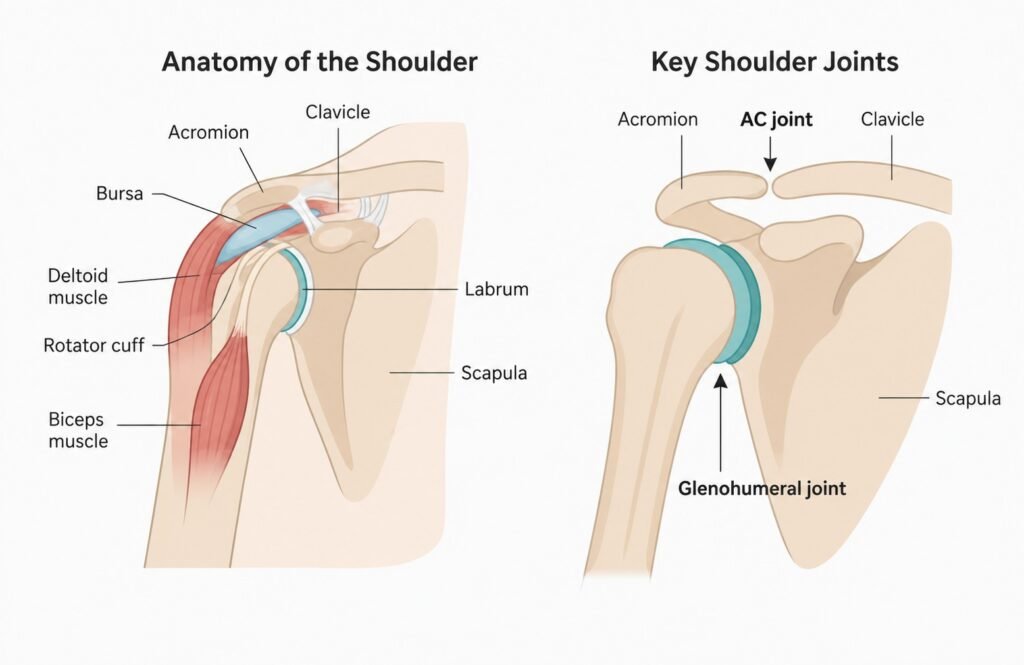
The shoulder is a complex joint that connects three bones: the humerus (upper arm), clavicle (collarbone), and scapula (shoulder blade). The head of the humerus fits into a shallow socket called the glenoid, allowing a wide range of motion.
Because this socket is relatively shallow, the shoulder is naturally less stable and more prone to injury.
Stability is maintained by ligaments, the joint capsule, and the rotator cuff—a group of four muscles that keep the joint aligned during movement and help control arm motion.
Because of its mobility and structure, the shoulder is especially vulnerable to common causes of shoulder pain.
Shoulder Pain Symptoms Explained
Shoulder pain can vary depending on the underlying cause. It may appear suddenly or develop gradually, and it can affect movement, strength, or even rest.
The most common symptoms are summarized in the table below.
| Symptom | Description | Possible Causes |
|---|---|---|
| Pain in shoulder | Dull, sharp, or throbbing pain in the front, side, or back of the shoulder | Rotator cuff injury, bursitis, arthritis |
| Shoulder pain when lifting arm | Pain increases when raising the arm or performing overhead movements | Impingement syndrome, rotator cuff tear, tendonitis |
| Pain in upper arm | Pain radiates from the shoulder down toward the upper arm | Rotator cuff injury, referred pain, nerve irritation |
| Neck and shoulder pain | Pain spreads from the neck to the shoulder, often with stiffness | Cervical spine issues, nerve compression, muscle strain |
| Night pain | Pain worsens at night or when lying on the affected side | Bursitis, tendonitis, inflammation |
| Stiffness | Reduced range of motion and difficulty moving the shoulder | Frozen shoulder, arthritis |
| Weakness | Reduced strength when lifting or holding objects | Rotator cuff tear, muscle injury |
| Swelling and warmth | Shoulder feels swollen, warm, or red | Inflammation, arthritis, infection |
| Clicking or popping | Clicking or catching sensation during movement | Joint instability, tendon movement, minor structural issues |
Key symptom patterns
- Pain may feel dull, sharp, or throbbing and can be located in different parts of the shoulder.
- In many cases, discomfort worsens during movement, especially when lifting the arm or reaching overhead.
- Some conditions cause pain to radiate into the upper arm or create neck and shoulder pain due to muscle or nerve involvement.
- Night pain is also common, particularly when lying on the affected side.
- Stiffness and reduced mobility can limit daily activities such as dressing or lifting objects.
- Weakness in the shoulder may occur in more serious cases, such as rotator cuff injuries.
- Swelling, warmth, or redness may indicate inflammation.
- Clicking or popping sounds are often harmless unless accompanied by pain.
Not sure what your shoulder pain symptoms actually mean? Use our detailed Shoulder Pain Diagnosis Chart to identify common pain locations, possible causes, and related symptoms.
8 Most Common Causes of Shoulder Pain
Shoulder pain can be caused by various conditions, ranging from muscle overuse to tendon injuries and joint disorders. Understanding the most common causes of shoulder pain can help you identify the source of your symptoms and choose the right treatment.
Related Guides


1. Shoulder Tendinitis and Tendinopathy
What it is
Shoulder tendinitis refers to irritation or inflammation of the rotator cuff tendons, while tendinopathy is a broader term that includes long-term degeneration of these tendons. Both conditions are common causes of shoulder pain, especially with repetitive use.
Types
- Acute tendinitis – develops suddenly after overload or repetitive overhead activity (e.g. sports, manual work)
- Chronic tendinopathy – develops gradually over time as tendons lose strength and elasticity
Symptoms
- Pain during movement, especially shoulder pain when lifting arm
- Tenderness in the shoulder
- Mild weakness or stiffness
- Pain in upper arm (in some cases)
When it hurts
Pain is most noticeable during overhead movements, lifting, or repetitive activities. It may worsen after activity.
Who is at risk
- Athletes (throwing sports, swimming)
- People with repetitive overhead work (painters, electricians)
- Adults with age-related tendon changes
Treatment options
- Activity modification and rest
- Physical therapy
- Anti-inflammatory medications
- Gradual return to movement
2. Shoulder Impingement Syndrome
What it is
Shoulder impingement syndrome occurs when the acromion (top of the shoulder blade) compresses the soft tissues beneath it during arm movement. This pressure irritates the rotator cuff tendons and the subacromial bursa, leading to pain and inflammation.
Symptoms
- Sharp pain when lifting the arm
- Pain at the front or side of the shoulder
- Shoulder pain when lifting arm above shoulder height
- Limited range of motion
When it hurts
Pain typically occurs during overhead movements, reaching, or lifting objects. It may worsen with repeated activity.
Common causes
- Repetitive overhead movements (e.g. painters, construction workers)
- Sports like swimming, tennis, or throwing
- Structural factors that reduce space in the shoulder joint
Treatment options
- Rest and activity modification
- Physical therapy
- Anti-inflammatory treatment
- Posture correction
Learn more about the symptoms, causes, diagnosis, and treatment of shoulder impingement syndrome in our detailed guide: Shoulder Impingement Syndrome Explained.
3. Rotator Cuff Tear (Tendon Rupture)
What it is
A rotator cuff tear occurs when one or more tendons in the shoulder become partially or completely detached from the bone. It most commonly affects the rotator cuff, but it can also involve the long head of the biceps tendon.
Types
- Partial tear – the tendon is damaged but not fully detached
- Full-thickness tear – the tendon is completely separated from the bone, affecting normal shoulder function
Symptoms
- Shoulder pain similar to impingement
- Weakness in the shoulder (key difference)
- Difficulty lifting or holding the arm
- Pain in upper arm
- Night pain
When it hurts
Pain may occur during movement, but the most important sign is pain combined with weakness, especially during lifting or overhead activity.
Key difference from impingement
If pain is present without weakness, impingement is more likely. If pain is accompanied by noticeable weakness, a tendon tear is more likely.
Who is at risk
- Adults over 40 (risk increases with age)
- People with long-term tendon degeneration
- Acute injuries (falls, sudden pulling movements)
Common causes
- Acute injury (fall, trauma, sudden force)
- Degenerative tear (gradual weakening of the tendon over time)
Treatment options
- Physical therapy
- Pain management
- In more severe cases, surgical repair may be required
Want to learn more? For a detailed guide on symptoms, diagnosis, and treatment of rotator cuff tears, read our full article: Rotator Cuff Tear: From Diagnosis to Treatment .
4. Shoulder Bursitis
What it is
Shoulder bursitis is the inflammation of a bursa—a small fluid-filled sac that acts as a cushion between bones, tendons, and muscles. Its role is to reduce friction and allow smooth movement within the joint.
In the shoulder, the most commonly affected is the subacromial bursa, located between the acromion and the rotator cuff tendons. It plays a key role during overhead arm movements.
Symptoms
- Pain on the outer side of the shoulder
- Tenderness to touch
- Shoulder pain when lifting arm
- Difficulty with daily activities (dressing, combing hair)
- Night pain, especially when lying on the affected side
When it hurts
Pain is usually worse during overhead movements or repetitive use of the arm. It can also become more noticeable at rest, especially at night.
Common causes
- Repetitive overhead activity
- Overuse or strain
- Often occurs together with rotator cuff tendinitis
Treatment options
- Rest and activity modification
- Ice therapy
- Anti-inflammatory medications
- Physical therapy
5. Frozen Shoulder (Adhesive Capsulitis)
What it is
Frozen shoulder, also known as adhesive capsulitis, is a condition in which the shoulder joint capsule becomes thickened and stiff, leading to pain and a significant loss of movement.
Symptoms
- Progressive stiffness
- Limited range of motion
- Dull, persistent shoulder pain
- Difficulty with everyday movements (dressing, reaching)
When it hurts
Pain is often worse in the early stages and may occur both at rest and during movement. Over time, stiffness becomes the dominant symptom.
Who is at risk
- Adults between 40 and 60 years old
- More common in women
- People with diabetes, thyroid disorders, or high cholesterol
Common causes
- Previous shoulder injury
- Rotator cuff problems or impingement
- Sometimes develops without a clear cause
Recovery and treatment
- Symptoms often improve gradually over months
- Stiffness can last up to 2–3 years
- Physical therapy is the main treatment
- Pain relief medications or corticosteroid injections may help
- Surgery is rarely needed
If your shoulder pain has gradually worsened over weeks or months and your movement feels increasingly restricted, you may be developing a frozen shoulder. Learn the key stages, symptoms, and treatment options in our full guide: Frozen Shoulder (Adhesive Capsulitis).
6. Shoulder Arthritis (Osteoarthritis and Inflammatory Arthritis)
What it is
Shoulder arthritis includes both osteoarthritis (degenerative joint disease) and inflammatory conditions such as rheumatoid arthritis, gout, or psoriatic arthritis. These conditions cause joint damage, pain, and stiffness over time.
Symptoms
- Deep, aching shoulder pain
- Progressive stiffness
- Reduced range of motion
- Grinding or clicking sensation in the joint
When it hurts
Pain often develops gradually and may occur during movement or at rest. Stiffness typically worsens over time.
Who is at risk
- Older adults (especially over 70)
- People with previous shoulder injuries
- Individuals with inflammatory joint diseases
Common causes
- Age-related cartilage degeneration (osteoarthritis)
- Previous trauma or long-term joint wear
- Inflammatory conditions (rheumatoid arthritis, gout, etc.)
Important note
Avoiding movement due to pain may worsen the condition. Reduced use of the shoulder can lead to joint stiffness and contracture, further limiting mobility.
Treatment options
- Physical therapy and regular movement
- Pain management (medications)
- Anti-inflammatory treatment
- In advanced cases, joint injections or surgery
7. Calcific Tendinitis (Calcium Deposits in the Shoulder)
What it is
Calcific tendinitis is a condition in which calcium deposits build up within the tendons of the rotator cuff. Although it can occur in other parts of the body, it most commonly affects the shoulder and is a frequent cause of both chronic and sudden shoulder pain.
Symptoms
- Sudden, severe shoulder pain
- Chronic, moderate pain over time
- Shoulder pain when lifting arm
- Limited range of motion
- Warmth in the shoulder (in acute phase)
Types of pain
- Acute pain – intense, sudden pain that may severely limit movement, sometimes without a clear trigger
- Chronic pain – ongoing discomfort that may fluctuate, often worse with activity or at night
When it hurts
Pain may appear suddenly or develop gradually. It often worsens with movement but can also be present at rest or during sleep.
Who is at risk
- Adults between 30 and 60 years old
- More common without a clearly identifiable cause
Common causes
- Exact cause is not fully understood
- Likely related to tendon degeneration and metabolic changes
Treatment options
- Anti-inflammatory medications
- Physical therapy
- Corticosteroid injections (often guided by ultrasound)
- Pain management during acute episodes
If your shoulder pain is sharp, sudden, or flares during lifting or reaching, calcific tendonitis may be the cause. Don’t wait for the pain to worsen — get clear guidance on symptoms, diagnosis, and fast, effective treatment in our full article: Calcific Tendonitis.
8. Referred Pain (Pain Originating from Other Areas)
What it is
Referred pain is shoulder pain that originates from another part of the body but is felt in the shoulder area. The pain is not caused by a local shoulder injury, but rather by irritation or disease elsewhere in the body.
The most common sources include the neck (cervical spine), chest, and abdominal organs.
Symptoms
- Shoulder and neck pain (neck and shoulder pain)
- Pain without clear shoulder injury
- Pain that does not worsen significantly with shoulder movement
- Possible radiating discomfort into the arm or back
Common sources of referred pain
- Cervical spine problems – nerve irritation or disc issues can cause pain radiating into the shoulder and arm
- Heart conditions (e.g. heart attack) – may cause pain spreading to the left shoulder, arm, jaw, or chest
- Gallbladder disease – can cause pain in the right shoulder or shoulder blade area
- Liver or pancreatic conditions – may also refer pain to the right shoulder or upper back
- Diaphragm irritation – can trigger pain referred to the shoulder region
When it hurts
Referred pain often does not follow typical shoulder movement patterns. It may occur at rest and is usually not directly triggered by lifting or moving the arm.
Why it is important
Because referred pain can be linked to serious internal conditions, it should not be ignored—especially if it is sudden, unexplained, or associated with chest pain, shortness of breath, or other systemic symptoms.
Treatment options
- Depends entirely on the underlying cause
- May require cardiac, gastrointestinal, or neurological evaluation
- Treating the root condition usually resolves the shoulder pain
When to See a Doctor
In most cases, shoulder pain improves with rest and conservative treatment. However, certain symptoms may indicate a more serious condition that requires medical evaluation.
Red flags include:
- Severe or worsening shoulder pain
- Inability to move the arm or shoulder
- Recent trauma or injury (fall, accident, direct impact)
- Sudden weakness in the arm
- Pain that does not improve over time
If any of these symptoms are present, it is important to seek medical attention to rule out serious injuries such as fractures, tendon tears, or internal causes of pain.
If you’re dealing with shoulder pain after a fall, sudden pull, or sports impact, it’s important to understand what may have been injured. For a clear, clinician‑level overview of the most common traumatic shoulder injuries — and what to do next — read our full guide here: Traumatic Shoulder Injuries.
How to Treat Shoulder Pain
Treatment for shoulder pain depends on the underlying cause, but most mild to moderate cases can be managed conservatively.
- Rest and activity modification – Avoid movements that trigger pain, especially overhead lifting or repetitive strain.
- Ice or heat therapy – Ice helps reduce acute inflammation and pain, while heat can improve stiffness and muscle relaxation.
- Physical therapy – Targeted exercises improve strength, mobility, and shoulder stability.
- Medications – Over-the-counter anti-inflammatory drugs can help reduce pain and swelling in the short term.
If symptoms persist or worsen, further medical evaluation may be needed to identify and treat the underlying cause.
Quick Shoulder Pain Diagnosis Guide
| Symptom Pattern | Pain Characteristics | Most Likely Condition |
|---|---|---|
| Pain when lifting arm or overhead activity | Sharp or pinching pain, worsens with movement | Rotator cuff injury, shoulder impingement |
| Pain in upper arm with shoulder weakness | Dull ache, loss of strength, difficulty lifting objects | Rotator cuff tear |
| Neck and shoulder pain | Radiating pain, possible tingling or stiffness | Cervical spine disorder, nerve compression |
| Night pain, worse when lying on shoulder | Deep aching pain, sleep disturbance | Bursitis, rotator cuff tendinopathy |
| Gradual stiffness and loss of motion | Progressive restriction in all directions | Frozen shoulder (adhesive capsulitis) |
| Sudden severe pain without clear injury | Intense, disabling pain, sometimes with warmth | Calcific tendinitis |
| Chronic deep joint pain with stiffness | Grinding sensation, reduced mobility | Shoulder arthritis |
| Pain not linked to shoulder movement | Referred or inconsistent pain pattern | Referred pain (neck, heart, gallbladder, etc.) |
Final Thoughts
Shoulder pain is a common but complex symptom that can result from a wide range of conditions, from simple overuse injuries to more serious tendon, joint, or nerve-related problems. Understanding the most common causes and recognizing key symptoms can help you better identify what may be behind your pain.
If your symptoms persist, worsen, or limit your daily activities, it is important to seek medical evaluation for an accurate diagnosis and appropriate treatment.
Lewis JS. Rotator cuff tendinopathy: a model for the continuum of pathology and related management. British Journal of Sports Medicine. Review article: Rotator cuff tendinopathy mechanisms and treatment
Seitz AL et al. Mechanisms of rotator cuff tendinopathy: intrinsic, extrinsic, or both? Clinical Biomechanics. Study on causes of rotator cuff disease and impingement
Yamamoto A et al. Prevalence and risk factors of a rotator cuff tear in the general population. Journal of Shoulder and Elbow Surgery. Epidemiological study on rotator cuff tears
Michener LA, McClure PW, Karduna AR. Anatomical and biomechanical mechanisms of subacromial impingement syndrome. Clinical Biomechanics. Study on biomechanical mechanisms of shoulder impingement
Uppal HS, Evans JP, Smith C. Frozen shoulder: A systematic review of therapeutic options. World Journal of Orthopedics. Systematic review of treatment options for adhesive capsulitis
Zuckerman JD, Rokito A. Frozen shoulder: a consensus definition. Journal of Shoulder and Elbow Surgery. Standardized definition and classification of frozen shoulder
Sansone V, Maiorano E. Calcific tendinopathy of the shoulder: clinical perspectives. Orthopedic Research and Reviews. Review of calcific tendinitis pathogenesis and management
Speed CA, Hazleman BL. Calcific tendinitis of the shoulder. New England Journal of Medicine. NEJM review of calcific tendon disease
van der Windt DA et al. Shoulder disorders in general practice: incidence and patient characteristics. Annals of the Rheumatic Diseases. Epidemiological data on shoulder pain in primary care
Luime JJ et al. Prevalence and incidence of shoulder pain in the general population. Scandinavian Journal of Rheumatology. Population-based study of shoulder pain prevalence
Hegedus EJ et al. Physical examination tests of the shoulder: a systematic review with meta-analysis. British Journal of Sports Medicine. Diagnostic accuracy of shoulder clinical tests
Mitchell C et al. Shoulder pain: diagnosis and management in primary care. BMJ. Clinical review of shoulder pain diagnosis and treatment
Diercks RL et al. Guideline for diagnosis and treatment of subacromial pain syndrome. Acta Orthopaedica. Evidence-based guideline for subacromial shoulder pain