
Golfers elbow, also known as medial epicondylitis, is a condition marked by pain and tenderness along the inner side of the elbow. The discomfort develops when the common flexor tendon becomes irritated due to repetitive movements that overload the structures on the medial side of the joint.
Symptoms typically worsen with activity — especially motions that involve repeated wrist flexion or forearm pronation (turning the forearm inward). As the name suggests, golfers elbow is common in sports such as golf, baseball, tennis, and handball. It also frequently appears in certain occupations that require repetitive or forceful manual work, including construction, carpentry, and similar trades.
In most cases, non‑operative treatment is sufficient, although recovery time varies depending on several factors. This article explains what golfers elbow is, how it develops, the typical symptoms, diagnostic methods, and the most effective treatment strategies for reducing medial elbow pain.
Key Clinical Points – Golfers Elbow (Medial Epicondylitis)
- Golfers elbow (medial epicondylitis) is an overuse condition that causes pain on the inner side of the elbow due to overload of the common flexor tendon.
- The condition is not limited to golfers and commonly affects people involved in repetitive gripping, wrist movements, throwing sports, and manual work.
- Diagnosis is usually based on symptoms and physical examination, with ultrasound often used to evaluate tendon changes and exclude other causes of elbow pain.
- Although the term medial epicondylitis suggests inflammation, golfers elbow is primarily considered a tendinopathy caused by repeated tendon overload and impaired adaptation.
- Conservative treatment is successful in most patients and includes activity modification, rehabilitation exercises, progressive tendon loading, and pain management strategies.
- Recovery varies depending on symptom severity, but many patients improve within 3–6 months with appropriate treatment and gradual return to activity.
What Is Golfers Elbow (Medial Epicondylitis)?
What Is Golfers Elbow (Medial Epicondylitis)?
Golfers elbow, also known as medial epicondylitis, is an overuse condition that causes pain on the inner side of the elbow. It occurs when the tendon structures on the medial side of the elbow become overloaded, leading to irritation, reduced tendon tolerance, and discomfort during activities that involve gripping, lifting, or repetitive wrist movements.
Despite its name, golfers elbow is not a condition that affects only golfers. It can develop in anyone who performs repeated movements involving the forearm muscles, such as athletes, manual workers, and people involved in repetitive daily activities.
The condition most commonly affects the common flexor tendon, which connects the forearm muscles responsible for wrist and finger movements to the inner part of the elbow. When repeated stress exceeds the tendon’s ability to recover, symptoms such as medial elbow pain and reduced grip strength may develop.
Although the term medial epicondylitis suggests inflammation, golfers elbow is now considered mainly a tendinopathy rather than a classic inflammatory condition. This means that the main issue is related to tendon overload and impaired adaptation to repeated stress rather than simple inflammation.
Golfers Elbow Anatomy
Golfers elbow affects the structures located on the inner side of the elbow, especially the area where the forearm muscles attach to the medial epicondyle of the humerus.
The main structure involved is the common flexor tendon, which connects several forearm muscles responsible for gripping, wrist movement, and forearm rotation.
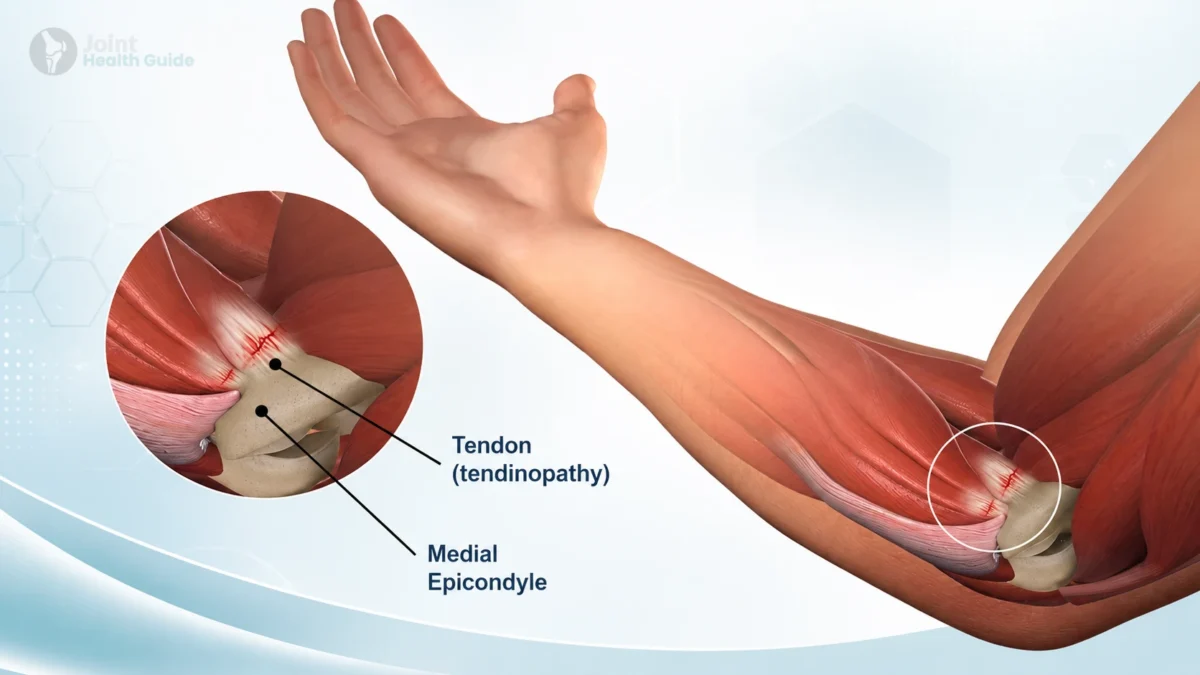
Medial Epicondyle and Common Flexor Tendon
The medial epicondyle is the bony prominence on the inner side of the elbow where the common flexor tendon attaches. This tendon transfers forces from the forearm muscles to the elbow during activities such as gripping, lifting, throwing, and swinging a golf club.
Repeated stress on this attachment can lead to irritation and reduced tendon tolerance, resulting in medial elbow pain and tenderness.
Muscles Involved
The muscles connected through the common flexor tendon help with:
- gripping objects
- bending the wrist
- bending the fingers
- turning the forearm inward (pronation)
Because these movements are repeated frequently during sports and manual work, the tendon can become overloaded over time.
Ulnar Nerve
The ulnar nerve runs close to the medial epicondyle, which is why nerve irritation can sometimes feel similar to golfers elbow.
However, ulnar nerve problems usually cause additional symptoms such as:
- tingling or numbness in the ring and little fingers
- weakness of the hand
- symptoms that worsen when the elbow stays bent for a long time
What Causes Medial Epicondylitis ?
Golfers elbow develops when the stress placed on the common flexor tendon repeatedly exceeds its ability to recover. In most cases, the condition is not caused by a single injury but develops gradually due to repeated overload of the tendon structures on the inner side of the elbow.
Activities that involve forceful gripping, repeated wrist flexion, or forearm pronation place increased tension on the common flexor tendon. When these movements are performed too frequently, with increased intensity, or without enough recovery time, the tendon may become less able to adapt to the mechanical demands placed on it.
Healthy tendons are designed to respond to gradual increases in load by becoming stronger and more resilient. However, when the balance between loading and recovery is disrupted, the tendon’s ability to tolerate stress decreases. Over time, this can lead to persistent irritation, reduced function, and the development of medial elbow pain during activities that involve the forearm and hand.
The pain associated with golfers elbow usually results from accumulated stress rather than a sudden traumatic event. Everyday activities such as lifting objects, carrying heavy loads, using tools, opening jars, or gripping sports equipment can increase tension through the affected tendon and aggravate symptoms.
Although the condition is often associated with golf, many other activities can contribute to its development. Throwing sports, tennis, climbing, weight training, and occupations involving repetitive or forceful manual work can all place similar demands on the common flexor tendon.
Despite the name medial epicondylitis, golfers elbow is not considered a classic inflammatory condition. Chronic cases are better understood as a form of common flexor tendinopathy, where the main problem is related to repeated tendon overload and an impaired ability of the tissue to adapt and recover.
Understanding why golfers elbow develops is important because treatment is not focused only on reducing pain. The goal is to gradually restore the tendon’s capacity to handle everyday activities, sports, and occupational demands.
Who Gets Golfers Elbow?
Although the name suggests that golfers elbow mainly affects golfers, the condition can develop in anyone who repeatedly places stress on the common flexor tendon. The key factor is not the specific sport or occupation, but repeated movements that involve gripping, wrist flexion, and forearm rotation.
Golfers elbow is most commonly seen in people who perform activities that require repetitive or forceful use of the forearm, including:
- Golfers – especially when technique, grip, or training volume places excessive stress on the inner side of the elbow
- Throwing athletes – such as baseball players and other athletes who repeatedly generate force through the forearm
- Tennis players – particularly those with repetitive forearm loading
- Weightlifters and gym enthusiasts – due to repeated gripping and lifting exercises
- Climbers – because of prolonged gripping demands on the forearm muscles
- Manual workers – including carpenters, construction workers, mechanics, plumbers, and electricians
- People performing repetitive hand activities – such as gardening, DIY work, or tasks involving frequent tool use
Certain factors may increase the likelihood of developing golfers elbow, including:
- A sudden increase in training intensity or workload
- Repetitive activities without enough recovery time
- Poor movement technique
- Reduced forearm strength or endurance
- Age-related changes in tendon capacity
Although golfers elbow can affect active people, it is not only a sports-related condition. Many cases occur in everyday life when repetitive loading exceeds the tendon’s ability to adapt and recover.
Golfers Elbow Symptoms
The most common symptom of golfers elbow is pain and tenderness on the inner side of the elbow, around the medial epicondyle. The pain is usually located over the attachment of the common flexor tendon and may spread along the inner side of the forearm.
During a physical examination, pressing on the area slightly below the medial epicondyle often reproduces the typical pain. Symptoms may also increase with movements that activate the affected tendon, especially wrist flexion (bending the wrist forward), forearm pronation (turning the palm downward), and activities that require gripping.
In most cases, medial elbow pain becomes worse during activity and improves with rest. However, as the condition progresses, some people may experience discomfort even during everyday activities or at rest.
Unlike some nerve-related conditions, golfers elbow typically does not cause numbness or tingling in the fingers.
Common symptoms of golfers elbow include:
- Pain on the inner side of the elbow (inner elbow pain)
- Tenderness around the medial epicondyle
- Pain when gripping objects or making a fist
- Discomfort during wrist flexion or forearm pronation
- Reduced grip strength
- Difficulty lifting, carrying, or holding objects
If the condition is not treated, symptoms may gradually worsen. Increasing pain and reduced grip strength can make daily activities more difficult, and in more advanced cases, objects may begin to slip from the hand due to weakness.
Golfers elbow can significantly affect quality of life by limiting work, sports, and simple everyday tasks that require repetitive use of the hand and forearm.
How Is Medial Epicondylitis Diagnosed?
The diagnosis of medial epicondylitis is usually made based on the patient’s symptoms, medical history, and a physical examination. In most cases, additional imaging tests are not required because the condition has a typical clinical presentation.
During the examination, the doctor will look for tenderness and pain on the inner side of the elbow, especially around the medial epicondyle and the attachment of the common flexor tendon. Pressure over this area often reproduces the patient’s typical pain, which may sometimes extend along the inner side of the forearm.
Several clinical tests can help confirm the diagnosis by increasing stress on the affected tendon. These tests typically involve movements that activate the forearm muscles, such as wrist flexion and forearm pronation against resistance. If these movements reproduce the characteristic medial elbow pain, the findings support the diagnosis of golfers elbow.
Imaging tests are usually reserved for cases where the diagnosis is uncertain, symptoms are severe, or there is a need to evaluate the condition of the tendon and exclude other causes of elbow pain.
Ultrasound examination is the most commonly used imaging method for golfers elbow because it is widely available, affordable, and allows real-time assessment of the tendon during movement. It can show changes associated with tendinopathy, including:
- Tendon thickening
- Changes in tendon structure
- Small partial tendon tears
- Calcifications within the tendon
- Changes at the tendon attachment site
Magnetic resonance imaging (MRI) can provide detailed images of the tendon and surrounding structures, but it is usually not necessary because ultrasound provides sufficient information in most cases.
An X-ray is not routinely needed for diagnosing golfers elbow, but it may be useful when there is suspicion of bone abnormalities, such as bone spurs or stress fractures.
If symptoms suggest involvement of the ulnar nerve, such as numbness, tingling in the ring and little fingers, or hand weakness, additional nerve testing such as electromyography (EMNG) may be required.
Golfers Elbow Treatment
In most cases, golfers elbow can be successfully treated with non-surgical methods. Treatment focuses on reducing stress on the common flexor tendon, improving tendon strength, and gradually restoring the ability to perform daily activities and sports without pain.
The best treatment approach depends on the severity and duration of symptoms. Most patients improve with a combination of activity modification, rehabilitation exercises, and other conservative treatments. In cases where symptoms persist despite appropriate treatment, additional procedures such as injections or surgery may be considered.
| Treatment option | When it is used | Main points |
|---|---|---|
| Activity modification | First-line treatment for most patients | Reduces tendon overload while allowing gradual return to normal activities |
| Braces and straps | During activities that provoke symptoms | May reduce stress on the common flexor tendon and decrease pain during movement |
| Physical therapy and exercises | Main component of long-term recovery | Improves tendon capacity through stretching, strengthening, and progressive loading exercises |
| Medications | For short-term symptom relief | NSAIDs and topical anti-inflammatory medications may reduce pain but do not treat the underlying tendon problem |
| Shockwave therapy (ESWT) | Chronic cases that do not improve with basic treatment | May stimulate tendon recovery and reduce pain in selected patients |
| Corticosteroid injections | Short-term pain relief when symptoms are significant | Can provide rapid relief but effects may not be long-lasting; repeated use requires caution |
| PRP injections | Persistent symptoms despite rehabilitation | Uses patient’s own platelet concentrate to support tendon healing responses |
| Percutaneous tenotomy | Chronic golfers elbow not responding to conservative treatment | Minimally invasive ultrasound-guided procedure targeting abnormal tendon tissue |
| Surgery | Rare cases with persistent pain and functional limitations | Removes damaged tendon tissue and repairs the tendon when other treatments fail |
Conservative Treatment for Golfers Elbow
Activity Modification
The first step in treating golfers elbow is reducing activities that repeatedly overload the tendon. This does not always mean complete rest. Instead, the goal is to modify painful movements and temporarily reduce activities that trigger symptoms.
For example, patients may need to adjust:
- training volume and intensity
- lifting technique
- grip position
- repetitive work activities
Gradually returning to normal activity is important because complete avoidance of loading can reduce tendon capacity over time.
Golfers Elbow Brace and Straps
Different types of braces can be used to reduce stress on the painful area.
A forearm strap placed slightly below the elbow is commonly used during activities. It helps distribute forces through the forearm and reduce tension at the tendon attachment.
A wrist brace may also be helpful because it limits wrist movements that increase stress on the common flexor tendon.
Medications
Pain-relieving medications may help reduce symptoms, especially during periods of increased discomfort.
Non-steroidal anti-inflammatory drugs (NSAIDs), such as ibuprofen or naproxen, may provide short-term pain relief. However, they should generally not be used for prolonged periods because of possible side effects.
Topical anti-inflammatory gels may be an alternative with fewer systemic side effects.
Physical Therapy and Exercises
Rehabilitation exercises are one of the most important parts of long-term recovery from golfers elbow.
A structured exercise program usually includes:
- stretching exercises for the forearm muscles
- strengthening exercises
- progressive loading of the flexor-pronator muscles
- eccentric exercises to improve tendon capacity
Physical therapy modalities such as shockwave therapy, laser therapy, therapeutic ultrasound, and TENS may be used in some patients, although exercise-based rehabilitation remains the foundation of treatment.
Injections for Medial Epicondylitis
Injections may be considered when symptoms of golfers elbow do not improve with activity modification, rehabilitation exercises, and other conservative treatments. They are usually not the first treatment option but may help reduce pain and support recovery in selected patients.
Corticosteroid Injections
Corticosteroid injections, often combined with a local anesthetic, can provide significant short-term relief of medial elbow pain. Many patients experience a rapid reduction in symptoms after the procedure.
However, corticosteroids do not address the underlying problem of tendon overload and may not provide long-lasting improvement. Repeated injections should be used with caution because corticosteroids can negatively affect tendon tissue when used excessively.
When corticosteroid injections are performed, ultrasound guidance is recommended because it allows accurate placement of the medication and helps avoid injecting directly into the tendon.
PRP Injections
PRP (platelet-rich plasma) injections involve injecting a concentrated preparation of platelets obtained from the patient’s own blood into the affected area of the tendon.
Platelets contain various biological substances that may support the body’s natural healing response. The goal of PRP treatment is to stimulate tendon recovery and improve the ability of the tissue to tolerate load.
Current research on PRP for common flexor tendinopathy shows promising results, especially in patients with chronic symptoms who have not improved with standard rehabilitation. However, outcomes can vary, and PRP is usually considered as part of a broader treatment plan that includes progressive exercise therapy.
Percutaneous Tenotomy (Ultrasound-Guided Tendon Treatment)
Percutaneous tenotomy is a minimally invasive procedure that may be considered for patients with chronic golfers elbow who do not improve with conservative treatment.
During the procedure, a needle or specialized instrument is inserted into the affected area of the common flexor tendon under ultrasound guidance. The goal is to stimulate a healing response within the tendon by creating controlled changes in the damaged tissue.
Because the procedure is performed through a small puncture rather than a surgical incision, recovery is usually faster compared with traditional surgery. However, proper rehabilitation and gradual tendon loading after the procedure are essential for optimal recovery.
Percutaneous tenotomy may be a treatment option for selected patients with persistent medial elbow pain despite appropriate non-surgical treatment.
Surgery for Medial Epicondylitis
Surgery is rarely needed for golfers elbow and is usually considered only when symptoms persist for at least 6–12 months despite appropriate non-surgical treatment, including activity modification, rehabilitation exercises, and other conservative methods.
The goal of surgery is to remove damaged tendon tissue and stimulate healing of the affected common flexor tendon. In some cases, the surgeon may also treat associated problems, such as ulnar nerve irritation, if present.
There are two main surgical approaches:
Open surgery involves a small incision over the inner side of the elbow, allowing the surgeon to directly access the affected tendon. Damaged tissue is removed, and the tendon may be repaired or reattached to the bone if necessary.
Arthroscopic surgery is performed through small incisions using a camera and specialized instruments. It may allow faster recovery and less scarring compared with open surgery, although it requires specific surgical expertise and carries a risk of injury to nearby structures, including the ulnar nerve.
After surgery, rehabilitation is an essential part of recovery. A gradual program of restoring elbow movement, strengthening the forearm muscles, and progressively loading the tendon helps patients return to normal activities and sports.
Because most patients improve with non-operative treatment, surgery is reserved for selected cases with persistent pain and significant functional limitations.
Medial Epicondylitis Recovery and Prognosis
The recovery time for golfers elbow varies depending on several factors, including the severity of the tendon problem, duration of symptoms, age, activity level, and how well the condition is managed.
Patients with milder forms of golfers elbow generally have a better prognosis because the tendon has less extensive changes and can respond more quickly to appropriate treatment. In contrast, chronic cases with more advanced tendon problems may require a longer rehabilitation period.
Age can also influence recovery. Younger patients often have a greater capacity for tissue adaptation and recovery, while older patients may need more time to regain tendon strength and function. Active athletes and people whose work involves repetitive use of the forearm may also require a longer recovery period because the affected tendon continues to experience higher physical demands.
How Long Does Golfers Elbow Take to Heal?
In many cases, recovery takes approximately 3 to 6 months with appropriate treatment and gradual return to activity. However, some patients with persistent or more advanced symptoms may require longer rehabilitation.
Recovery after surgical treatment is usually longer and may take 6 to 12 months, depending on the type of procedure and the individual’s response to rehabilitation.
It is important to understand that these timeframes are only estimates. Every case of golfers elbow is different, and recovery depends on factors such as symptom severity, treatment approach, activity modification, and adherence to rehabilitation.
Although most patients improve with non-surgical treatment, some individuals may continue to experience symptoms despite appropriate care and require additional procedures.
How to Prevent Golfers Elbow?
Preventing golfers elbow is mainly about managing the amount of stress placed on the common flexor tendon and allowing enough time for recovery. Since the condition usually develops gradually from repeated overload, small changes in training habits, work technique, and daily activities can reduce the risk of recurrence.
Important prevention strategies include:
- Gradually increase activity levels – avoid sudden increases in training volume, intensity, or repetitive work demands.
- Use proper technique – correct movement patterns in sports and occupational activities can reduce unnecessary stress on the tendon.
- Strengthen the forearm muscles – regular strengthening exercises help improve the tendon’s ability to tolerate load.
- Allow adequate recovery time – avoid repetitive activities without sufficient rest between sessions.
- Use appropriate equipment – proper grip size, sports equipment, and tools may reduce excessive strain on the forearm.
- Address early symptoms – treating mild pain and modifying aggravating activities early may prevent progression to a chronic condition.
For people who have previously experienced golfers elbow, returning gradually to full activity is important. A sudden return to the same workload that caused the problem can increase the risk of symptoms coming back.
Frequently Asked Questions About Golfers Elbow
Is golfers elbow the same as tennis elbow?
No. Although both conditions involve tendon problems around the elbow, they affect different areas. Golfers elbow causes pain on the inner side of the elbow and involves the common flexor tendon, while tennis elbow affects the outer side of the elbow and involves the extensor tendons.
How long does golfers elbow take to heal?
Recovery time varies depending on the severity of the condition and the treatment approach. Many patients improve within 3 to 6 months, although chronic cases may require longer rehabilitation.
Can golfers elbow heal without surgery?
Yes. Most cases improve with non-surgical treatment, including activity modification, rehabilitation, and gradual strengthening. Surgery is reserved for patients with persistent symptoms despite appropriate treatment.
What is the fastest way to relieve golfers elbow pain?
Reducing activities that aggravate symptoms, modifying movements, and using appropriate pain-relief strategies can help decrease discomfort. However, long-term recovery usually requires restoring tendon strength through rehabilitation.
Can I continue exercising with golfers elbow?
In many cases, complete rest is not necessary. Activities that do not increase pain can often be continued, while movements that significantly aggravate symptoms should be temporarily modified.
Does PRP help golfers elbow?
PRP injections may help some patients with chronic golfers elbow, especially when symptoms persist despite conservative treatment. However, results vary, and PRP is usually combined with a structured rehabilitation program.
Can golfers elbow come back?
Yes. Symptoms may return if the tendon is exposed to the same excessive workload without adequate recovery. Gradual progression of activity and continued strengthening can help reduce the risk of recurrence.
Iriarte I, Pedret C, Balius R, Cerezal L. Ultrasound of the Musculoskeletal System. MSK Room, Bilbao, Spain. 2021. Reference textbook: Musculoskeletal ultrasound evaluation and imaging techniques
Frontera WR, Silver JK, Rizzo TD Jr, et al. Essentials of Physical Medicine and Rehabilitation: Musculoskeletal Disorders, Pain, and Rehabilitation. 4th edition. Elsevier. 2018. Clinical reference: Musculoskeletal diagnosis, rehabilitation, and pain management
Arevalo A, Rao S, Willier DP, et al. Surgical Techniques and Clinical Outcomes for Medial Epicondylitis: A Systematic Review. The American Journal of Sports Medicine. 2022;51(9):2506-2515. doi:10.1177/03635465221095565. Systematic review: Surgical techniques and outcomes for medial epicondylitis
DeLuca MK, Cage E, Stokey PJ, Ebraheim NA. Medial Epicondylitis: Current Diagnosis and Treatment Options. Journal of Orthopaedic Reports. 2023;2(3). Review article: Current diagnosis and treatment approaches for medial epicondylitis
Konarski W, Poboży T, Poboży K, Domańska J, Konarska K. Current Concepts of Natural Course and in Management of Medial Epicondylitis: A Clinical Overview. Orthopedic Reviews (Pavia). 2023;15:84275. doi:10.52965/001c.84275. Clinical overview: Natural history and management of medial epicondylitis
Grezlák A. Medial Epicondylitis: A Systematic Review on Causes, Symptoms and Treatment. Quality in Sport. 2024;36:56572. Systematic review: Causes, symptoms, and treatment of medial epicondylitis