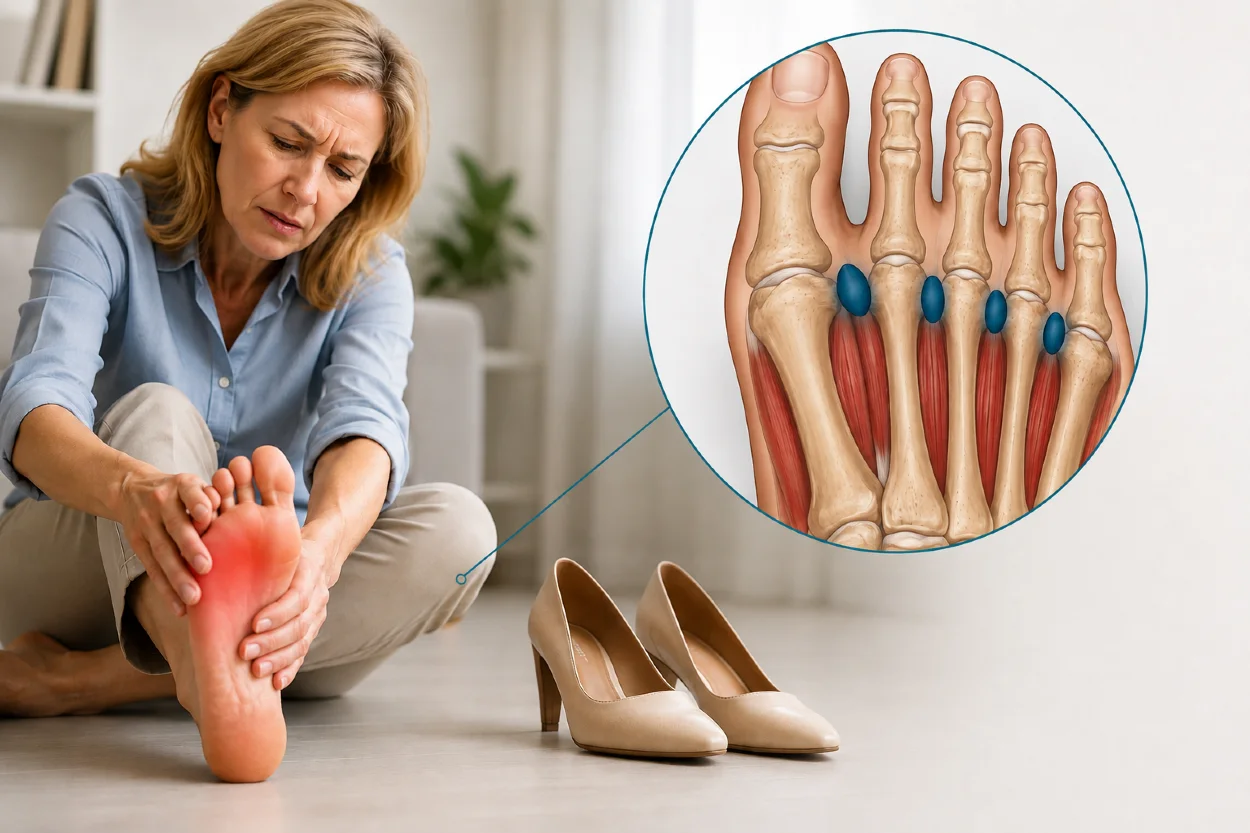
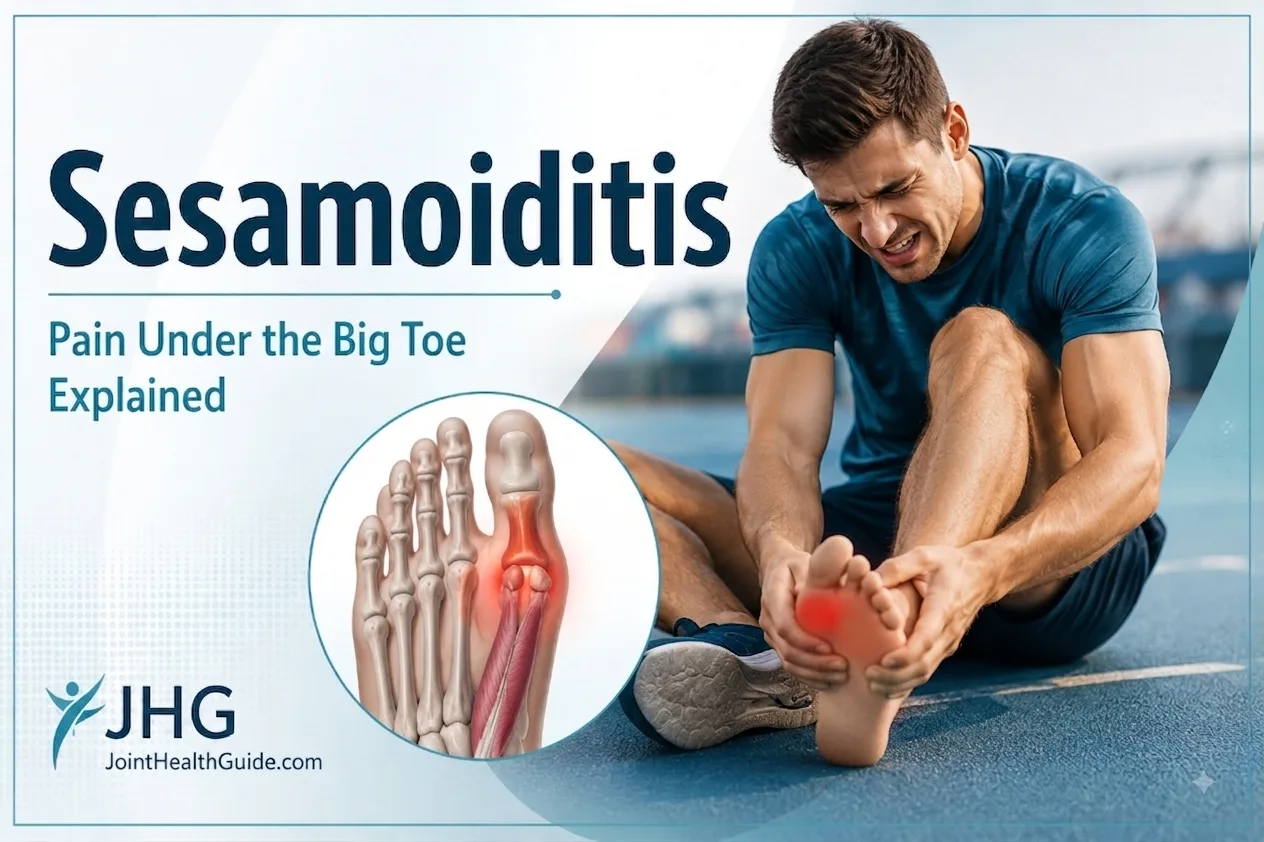
Sesamoiditis is a common cause of pain beneath the big toe. It affects the small sesamoid bones located beneath the head of the first metatarsal, which help absorb pressure and support movement of the big toe.
The condition usually develops from repetitive stress, particularly in runners, dancers, and people involved in activities that place high loads on the forefoot. Pain and tenderness are typically worse when walking, running, or bending the big toe upward.
Treatment focuses on reducing pressure on the sesamoids and may include activity modification, footwear changes, padding or orthotics, physical therapy, and temporary immobilization. Persistent pain may require imaging to rule out a fracture or another underlying condition.
What Is Sesamoiditis?
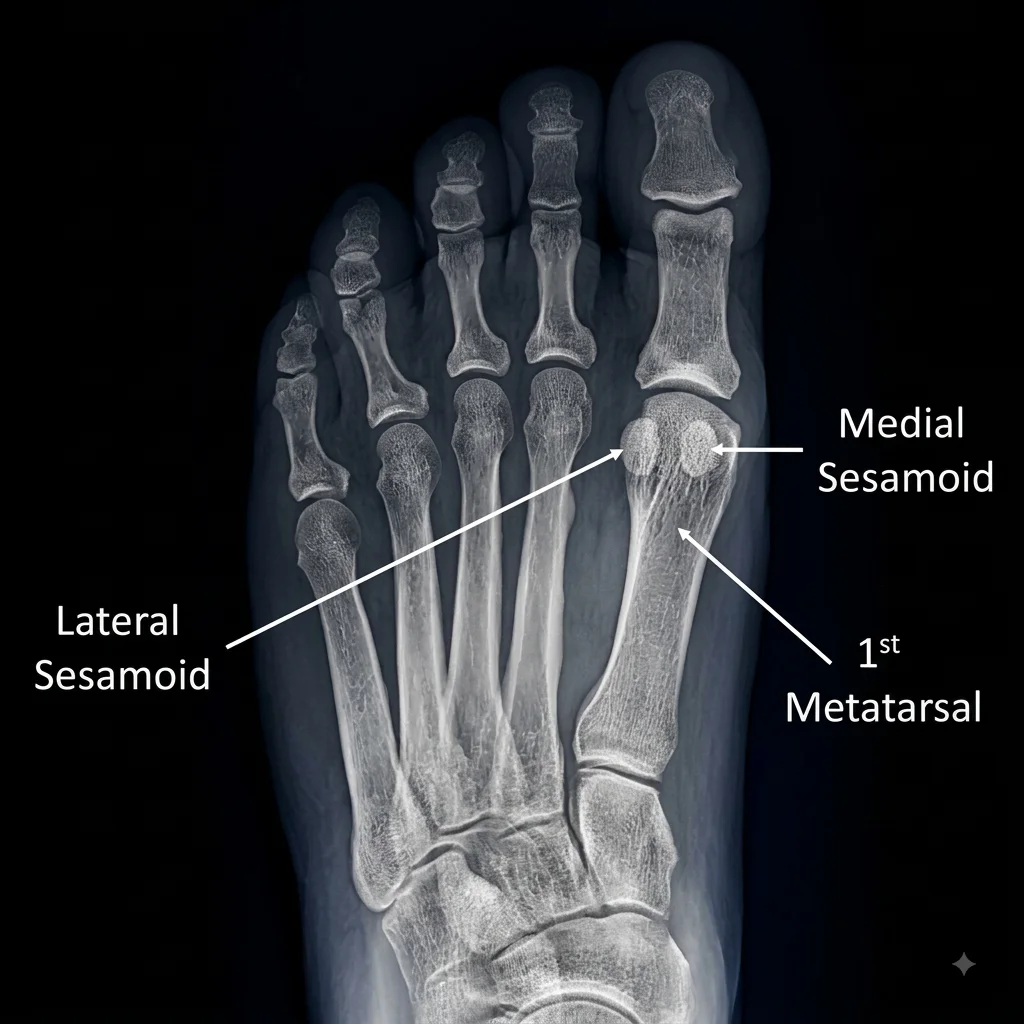
Sesamoids are two small bones located beneath the head of the first metatarsal, where they form part of the first metatarsophalangeal (MTP) joint. The medial sesamoid, also called the tibial sesamoid, is usually larger than the lateral sesamoid, or fibular sesamoid.
These bones are embedded within the tendons of the flexor hallucis brevis and help protect the tendon and the plantar surface of the first MTP joint. They also act as pulleys, helping the big toe move efficiently while reducing friction and distributing forces through the forefoot.
Sesamoids play an important role during weight-bearing and push-off. They absorb and redistribute pressure beneath the first metatarsal head and provide mechanical leverage for the muscles that move the big toe.
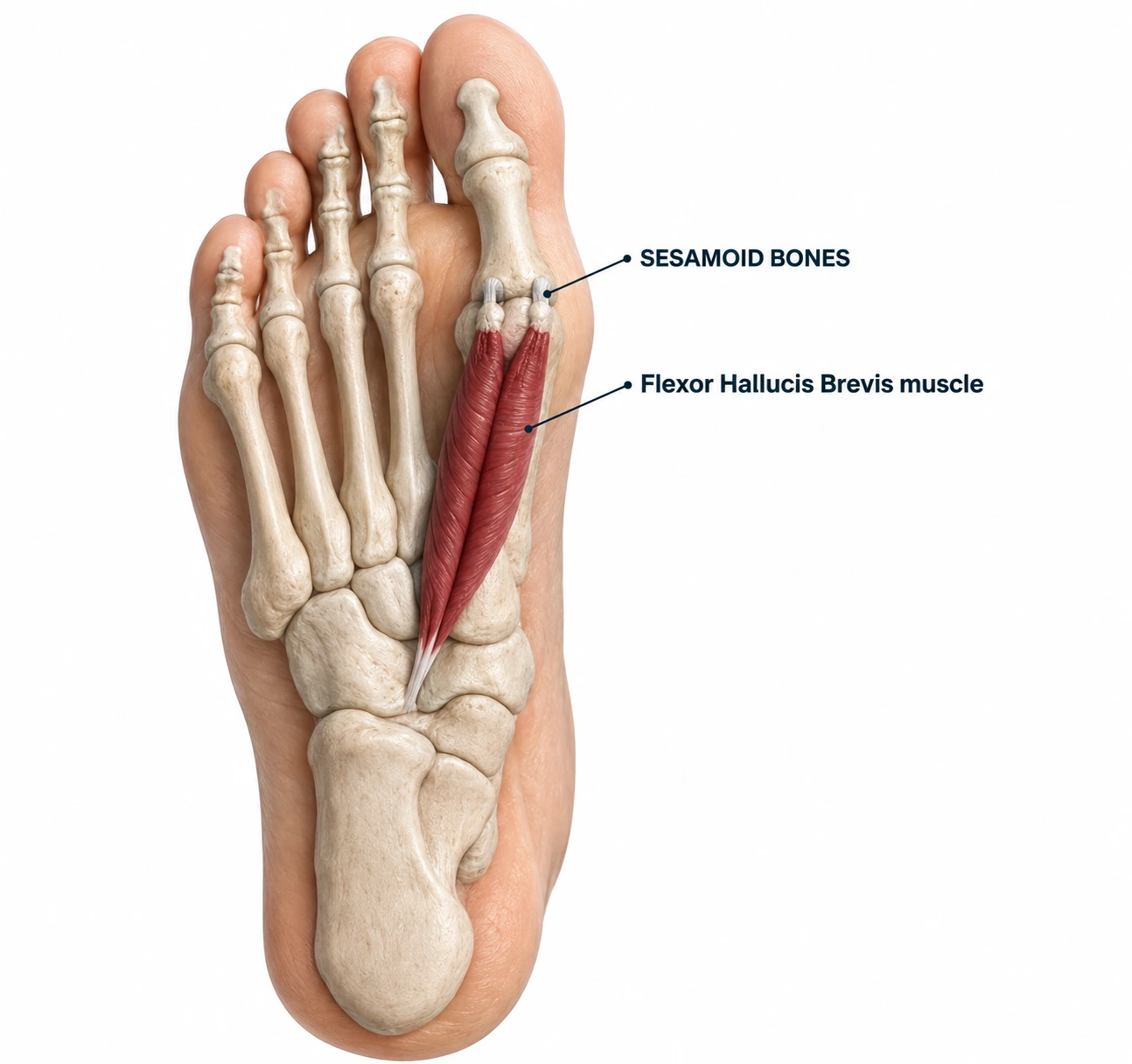
The term sesamoiditis generally refers to pain and irritation involving the sesamoid complex, most often caused by repetitive loading or overuse. Despite its name, sesamoiditis does not necessarily mean inflammation of the bone itself. Similar symptoms can occur with stress injuries, fractures, osteonecrosis, or other conditions affecting the sesamoids and surrounding tissues.
Sesamoiditis Symptoms
The main symptom of sesamoiditis is pain beneath the big toe, usually localized around the sesamoid bones beneath the head of the first metatarsal. The pain may initially be mild and only occur during certain activities, but it can become more persistent as irritation increases.
What Does Sesamoiditis Feel Like?
Sesamoiditis typically causes localized tenderness directly over the sesamoids. Pain is often worse when walking, running, pushing off the toes, or bending the big toe upward. Activities that place greater pressure on the forefoot, such as jumping or running, may significantly increase symptoms.
Other possible symptoms include:
- Pain when putting weight on the ball of the foot
- Pain during push-off while walking or running
- Pain with passive dorsiflexion of the big toe
- Tenderness when pressing directly over the sesamoid bones
- Swelling around the base of the big toe
- Bruising after an acute injury
- Difficulty bearing weight on the forefoot
Symptoms are usually localized to the underside of the big toe rather than the entire forefoot. Sudden severe pain, significant swelling or bruising, or difficulty bearing weight after an injury may suggest a fracture or another acute injury rather than uncomplicated sesamoiditis.
What Causes Sesamoiditis?
Sesamoiditis usually develops when the sesamoid bones and surrounding tissues are exposed to repeated or excessive stress. In some cases, symptoms can also follow an acute injury to the big toe.
Repetitive Stress
Activities such as running, jumping, dancing, and sports place repeated pressure on the ball of the foot and sesamoid complex. A sudden increase in training intensity or duration can further increase the risk.
Sudden Dorsiflexion of the Big Toe
Forceful bending of the big toe upward can place significant stress on the sesamoids and the surrounding soft tissues. This may occur during sports or after an awkward step.
Footwear
Shoes that place excessive pressure on the ball of the foot can increase stress on the sesamoids. High heels and shoes with a narrow or poorly fitting toe box may contribute to symptoms by shifting more weight toward the forefoot.
Foot Biomechanics
The way the foot distributes load during walking and running can influence the amount of stress placed on the sesamoids. Factors such as excessive pronation, altered forefoot loading, and other biomechanical abnormalities may contribute to repetitive irritation.
Previous Foot Problems
Conditions affecting the first metatarsophalangeal joint or surrounding structures may increase stress on the sesamoid complex. These include turf toe, hallux rigidus, first MTP joint arthritis, and previous injuries to the big toe.
Who Is at Risk of Sesamoiditis?
Sesamoiditis can affect anyone, but the risk is higher in people who repeatedly place high loads on the ball of the foot.
- Runners, particularly those who suddenly increase their training volume or intensity
- Dancers, who frequently perform movements that load the forefoot and big toe
- Athletes involved in running, jumping, or rapid changes of direction
- People involved in jumping sports, such as basketball and volleyball
- People who stand or walk for prolonged periods, especially on hard surfaces
- People with certain foot biomechanics, which may increase pressure on the sesamoid complex
- People who regularly wear high heels or poorly fitting footwear, which can increase forefoot pressure
How Is Sesamoiditis Diagnosed?
The diagnosis of sesamoiditis is primarily clinical, based on the location and characteristics of the pain, physical examination, and assessment of factors that may be contributing to excessive sesamoid loading. Imaging is used when necessary to confirm the diagnosis, assess the severity of the condition, and exclude other causes of pain.
Medical History
The clinician will ask about the onset of symptoms, recent changes in physical activity, sports participation, previous injuries, footwear, and activities that aggravate the pain. Gradual onset after repetitive loading is typical of sesamoiditis, while sudden pain following trauma raises suspicion of a fracture or other acute injury.
Physical Examination
Examination focuses on the plantar aspect of the first metatarsophalangeal joint. Localized tenderness directly over one or both sesamoids is a typical finding. The clinician also assesses swelling, range of motion of the big toe, gait, and the ability to bear weight on the forefoot.
Reproducing the Pain
Pain can often be reproduced by direct pressure over the sesamoids, loading the forefoot, or dorsiflexing the big toe. These findings help localize the source of symptoms and distinguish sesamoid pathology from other causes of forefoot pain.
Assessing Foot Biomechanics
The clinician may assess gait, foot posture, forefoot loading, footwear, and other biomechanical factors that could increase stress on the sesamoid complex. Identifying these factors is particularly important when symptoms are related to repetitive activity.
X-rays
X-rays are usually the first imaging test when a bony injury is suspected. They can identify sesamoid fractures, degenerative changes, abnormal bone morphology, and other structural abnormalities. Comparison with the opposite foot may sometimes help distinguish a fracture from a naturally bipartite sesamoid.
Ultrasound
Ultrasound can provide a dynamic assessment of the sesamoid region and surrounding soft tissues. It may help identify soft-tissue abnormalities, tendon pathology, fluid collections, and focal tenderness and can be useful when evaluating the structures around the sesamoids.
MRI and CT
MRI is particularly useful when symptoms persist despite initial treatment or when there is concern for a stress injury, bone marrow edema, osteonecrosis, or soft-tissue pathology. CT provides more detailed assessment of bone architecture and may be useful for characterizing fractures or other bony abnormalities.
Clinical Insight
Sesamoiditis is primarily a clinical diagnosis, but persistent or severe symptoms should not automatically be attributed to sesamoiditis. Imaging is important when a fracture, stress injury, osteonecrosis, or another source of plantar forefoot pain needs to be excluded.
Other Conditions That Can Cause Pain Under the Big Toe
Pain beneath the big toe is not always caused by sesamoiditis. Several conditions can affect the sesamoids, the first metatarsophalangeal joint, or the surrounding soft tissues and produce similar symptoms.
- Sesamoid fracture – may cause sudden pain, swelling, and tenderness after an injury.
- Sesamoid stress fracture – usually develops gradually from repetitive loading and may resemble sesamoiditis.
- Osteonecrosis of a sesamoid – impaired blood supply can lead to bone damage and persistent pain.
- Osteochondral lesion – damage to the bone and cartilage can affect the sesamoid or first MTP joint.
- Hallux rigidus or first MTP osteoarthritis – degeneration of the joint can cause pain around the base of the big toe, particularly during dorsiflexion.
- Turf toe – an injury to the plantar structures of the first MTP joint, often caused by forced hyperextension of the big toe.
- Flexor hallucis brevis or flexor hallucis longus pathology – tendon-related disorders can cause pain around the sesamoid complex.
- Gout – acute inflammation of the first MTP joint can cause severe pain, swelling, redness, and warmth.
- Infection – uncommon but important to consider, particularly when pain is accompanied by redness, warmth, swelling, or systemic symptoms.
Because these conditions can produce similar symptoms, persistent or severe pain beneath the big toe should be properly evaluated rather than assumed to be sesamoiditis. The clinical examination and, when indicated, imaging help determine the underlying cause and guide appropriate treatment.
Sesamoiditis vs. Sesamoid Fracture
Sesamoiditis and a sesamoid fracture can cause very similar symptoms, making them difficult to distinguish based on symptoms alone. The onset of pain and the presence of trauma can provide important clues, but imaging may be needed when a fracture is suspected.
| Feature | Sesamoiditis | Sesamoid Fracture |
|---|---|---|
| Onset | Usually gradual | Often sudden after trauma or acute overload |
| Typical cause | Repetitive stress and overuse | Acute injury or repetitive stress causing a stress fracture |
| Pain | Usually develops gradually and worsens with activity | Often more sudden and intense, particularly after injury |
| Tenderness | Localized over the affected sesamoid | Usually marked and localized over the fracture |
| Swelling / Bruising | Usually mild or absent | May occur, particularly after an acute fracture |
| Weight-bearing | Painful, especially during push-off | May be significantly painful or difficult |
| Imaging | May be normal; imaging is used when another condition is suspected | X-ray, MRI, or CT may be needed to confirm the fracture |
The two conditions can overlap clinically, and a stress fracture may initially resemble sesamoiditis. Persistent, worsening, or severe pain—especially after an injury—should therefore be evaluated to exclude a fracture or other structural abnormality.
Sesamoiditis Treatment
Treatment for sesamoiditis is usually conservative and focuses on reducing pressure on the sesamoid complex while allowing the irritated tissues to recover. The approach should be adjusted according to the severity of symptoms and whether an underlying bone or joint problem is present.
Initial Treatment
The first step is to reduce activities that reproduce pain, particularly running, jumping, and prolonged forefoot loading. This does not necessarily mean complete rest. Instead, painful activities should be temporarily modified and gradually reintroduced as symptoms improve.
Other initial measures include:
- Wearing comfortable, supportive footwear
- Using shoes with a stiff or supportive sole
- Avoiding high heels and activities that increase forefoot pressure
- Using cushioning or padding to reduce pressure beneath the sesamoids
- Temporary use of pain-relieving medication or NSAIDs when appropriate
Offloading and Orthotics
Offloading is one of the most important aspects of conservative treatment. The goal is to reduce pressure directly beneath the affected sesamoid while maintaining comfortable function.
A soft pad or custom orthotic can redistribute pressure away from the painful area. A sesamoid pad with an opening beneath the affected bone may be particularly useful. Orthotics can also be used to address biomechanical factors that contribute to excessive forefoot loading.
Immobilization
For more painful cases, temporary immobilization may be necessary to reduce mechanical stress and allow the sesamoid complex to recover. Options include:
- Taping the big toe
- Stiff-soled shoes
- Orthoses
- A walking boot for more severe or persistent symptoms
Immobilization should generally be temporary, followed by a gradual return to normal loading and movement.
Physical Therapy and Rehabilitation
Once acute pain has improved, rehabilitation can help restore normal function and reduce the risk of recurrence. Treatment may include:
- Gradual progression of weight-bearing
- Restoring comfortable first MTP joint mobility
- Strengthening the foot and intrinsic muscles
- Addressing contributing biomechanical factors
- Improving gait and forefoot loading
- Gradual return to running and sports
The rehabilitation program should progress according to symptoms rather than a fixed timeline. Pain that consistently increases after activity is a sign that loading should be reduced.
Corticosteroid Injections
Corticosteroid injections may be considered in selected patients with persistent pain and can provide relatively rapid symptom relief. They may be particularly useful when pain is limiting daily activities or preventing progression through rehabilitation.
The goal is symptom control rather than correction of the underlying mechanical cause, so injections should be considered as an adjunct to the overall treatment plan.
Shockwave Therapy and Other Treatments
Extracorporeal shockwave therapy (ESWT) may be considered in patients with persistent symptoms who do not respond adequately to initial conservative treatment. Other physical modalities may also be used depending on the clinical presentation.
These treatments are generally considered adjunctive options rather than first-line treatment for sesamoiditis.
When Is Surgery Needed?
Most patients are initially treated without surgery. Surgical treatment may be considered when pain remains persistent despite an adequate course of appropriate conservative treatment or when there is significant structural pathology.
Potential indications include:
- Persistent disabling pain despite conservative treatment
- Symptomatic osteonecrosis
- Fracture or fracture nonunion
- Significant structural damage
- Refractory symptoms affecting daily activities or sports
Surgery should therefore be considered on an individual basis, after confirming the underlying cause of symptoms and exhausting appropriate non-surgical treatment options.
How to Prevent Sesamoiditis
Preventing sesamoiditis largely involves reducing excessive and repetitive stress on the forefoot. Helpful measures include:
- Gradually increasing training load, particularly when starting a new activity or returning to sport
- Wearing appropriate footwear with adequate cushioning and support
- Managing training load and allowing sufficient recovery between high-impact activities
- Using offloading or protective padding when there is increased pressure on the sesamoids
- Addressing contributing biomechanical factors that may increase forefoot loading
- Replacing worn-out athletic shoes when they no longer provide adequate support and cushioning
When Should You See a Doctor?
You should seek medical evaluation if you have:
- Severe pain after an injury, particularly after forced bending of the big toe
- Difficulty or inability to bear weight normally
- Significant swelling or bruising around the big toe
- Pain that does not improve despite reducing activity and pressure on the area
- Recurrent episodes of sesamoid pain
- Persistent pain that interferes with walking, work, or sports
- Symptoms that raise concern for a fracture, stress injury, or another underlying condition
Sesamoiditis FAQ
What is sesamoiditis?
Sesamoiditis is a painful condition affecting the sesamoid complex beneath the big toe. It is most often related to repetitive stress and overuse, causing pain and tenderness beneath the head of the first metatarsal.
What does sesamoiditis feel like?
Sesamoiditis typically causes localized pain and tenderness beneath the big toe. Pain is often worse when walking, running, pushing off the toes, or bending the big toe upward. Direct pressure over the sesamoids may also reproduce the pain.
What causes sesamoiditis?
The most common cause is repetitive loading of the forefoot, particularly during running, jumping, dancing, and other high-impact activities. Sudden increases in activity, inappropriate footwear, and biomechanical factors can also increase stress on the sesamoids.
How is sesamoiditis diagnosed?
Diagnosis is primarily based on the history and physical examination, particularly localized tenderness over the sesamoids and pain with forefoot loading or big-toe movement. X-rays, ultrasound, MRI, or CT may be used when a fracture, stress injury, osteonecrosis, or another condition needs to be ruled out.
How long does sesamoiditis take to heal?
Recovery time varies depending on the severity of the condition and how quickly the source of excessive loading is addressed. Mild cases may improve within several weeks, while more persistent cases can take several months. Continuing to overload the painful area can significantly delay recovery.
Can you walk with sesamoiditis?
Yes, many people can continue walking, but walking may be painful, particularly during push-off. Reducing painful activities, modifying footwear, and temporarily decreasing pressure on the sesamoids can make walking more comfortable. Severe pain or difficulty bearing weight warrants medical assessment.
Can you run with sesamoiditis?
Running is generally best reduced or temporarily avoided when it reproduces pain. Once symptoms have settled, running can be gradually reintroduced, increasing distance and intensity according to tolerance. Returning to running too quickly may prolong symptoms.
What shoes are best for sesamoiditis?
Shoes with a comfortable, supportive, and relatively stiff sole can reduce bending and pressure around the sesamoids. Adequate cushioning and sufficient space for the toes are also important. High heels and footwear that increases pressure on the forefoot are best avoided while symptoms are active.
Is sesamoiditis the same as a sesamoid fracture?
No. Sesamoiditis usually develops from repetitive stress and irritation, whereas a sesamoid fracture involves a break in the bone. However, a stress fracture can develop gradually and produce symptoms very similar to sesamoiditis, so persistent or severe pain may require imaging.
Can sesamoiditis heal without surgery?
Yes. Most cases are initially managed conservatively, with treatment focused on reducing painful loading and allowing the sesamoid complex to recover. Surgery is generally reserved for persistent symptoms or specific structural problems that do not respond adequately to appropriate non-surgical treatment.
Kaur P, Carroll MR, Stewart S. The assessment and management of sesamoiditis: a focus group study of podiatrists in Aotearoa New Zealand. J Foot Ankle Res. 2023;16(1):29. Research study: Assessment and management of sesamoiditis in clinical practice
Biz C et al. Conservative Treatment of Sesamoiditis: A Systematic Literature Review with Individual-Level Pooled Data Analysis. Medicina (Kaunas). 2025;61(7):1215. Systematic review: Conservative treatment and outcomes of sesamoiditis