

Intermetatarsal bursitis is a condition that causes pain and inflammation in one of the small fluid-filled bursae located between the metatarsal bones in the forefoot. It commonly causes pain, burning, pressure, or tenderness between the toes, particularly when walking or wearing tight-fitting shoes.
Because its symptoms can be very similar to those of Morton’s neuroma, intermetatarsal bursitis is sometimes difficult to recognize based on symptoms alone. The two conditions can also occur at the same time, making an accurate diagnosis particularly important.
Intermetatarsal bursitis usually develops when repeated pressure or friction irritates the bursa. Activities that place excessive stress on the ball of the foot, narrow shoes, high heels, and certain foot mechanics can all contribute to its development.
In this guide, we will explain what intermetatarsal bursitis is, what causes it, its typical symptoms, how it is diagnosed, and which treatments can help relieve pain and restore normal function.
Quick Overview – Intermetatarsal bursitis
- Intermetatarsal bursitis is inflammation and distension of a small bursa located between the metatarsal heads, causing pain and tenderness in the forefoot.
- Common causes include repetitive forefoot pressure, tight footwear, high heels, and altered foot mechanics. It can also occur in association with inflammatory conditions such as rheumatoid arthritis.
- Typical symptoms include pain, burning, tenderness, pressure, or a “pebble” sensation between the toes, often aggravated by walking or tight shoes.
- Ultrasound and MRI can demonstrate a distended intermetatarsal bursa, but a small amount of fluid does not necessarily indicate symptomatic bursitis. Imaging findings should be interpreted in correlation with clinical symptoms and examination.
- Treatment is usually conservative and includes activity modification, appropriate footwear, metatarsal pads or orthotics, and pain relief. Persistent cases may benefit from ultrasound-guided corticosteroid injection, while surgery is rarely required.
What Is Intermetatarsal Bursitis?
A bursa is a small, fluid-filled sac that helps reduce friction between tissues that move against each other. Bursae are found throughout the body, usually near joints and areas exposed to repeated pressure or movement. Under normal conditions, a bursa is thin and contains only a small amount of fluid.
Intermetatarsal bursae are small bursae located in the forefoot, between the metatarsal bones. They are positioned near the metatarsal heads, where the forefoot experiences considerable pressure during walking and other weight-bearing activities. Their primary function is to reduce friction and allow the surrounding tissues to move smoothly.
Anatomy of the Forefoot
The forefoot contains five metatarsal bones that connect the midfoot to the toes. The rounded ends of these bones, called the metatarsal heads, form the ball of the foot and bear a significant portion of body weight during walking.
Intermetatarsal bursae are located in the spaces between adjacent metatarsal heads. They lie close to other important structures, including the plantar plates, flexor tendons, and digital nerves. This close anatomical relationship is one reason why inflammation of an intermetatarsal bursa can produce symptoms that resemble other conditions affecting the forefoot, particularly Morton’s neuroma.
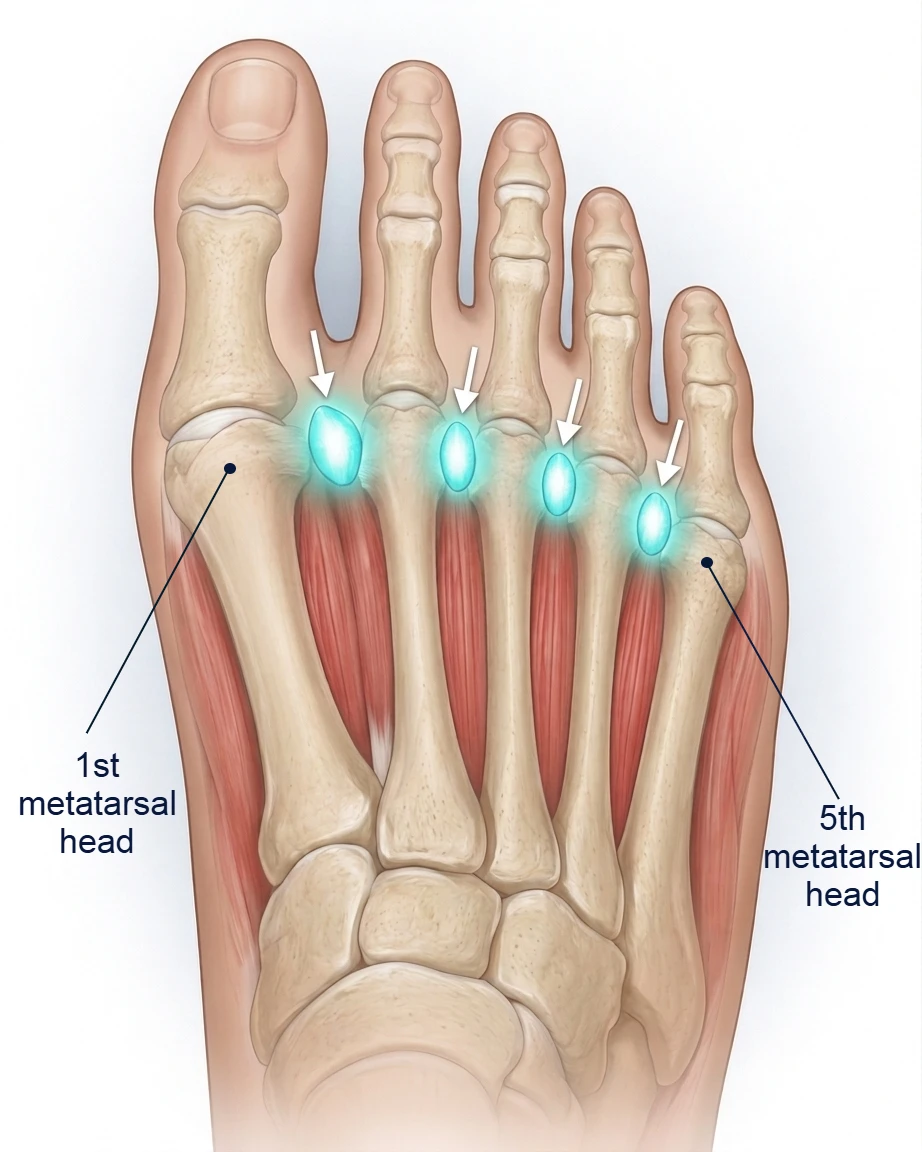
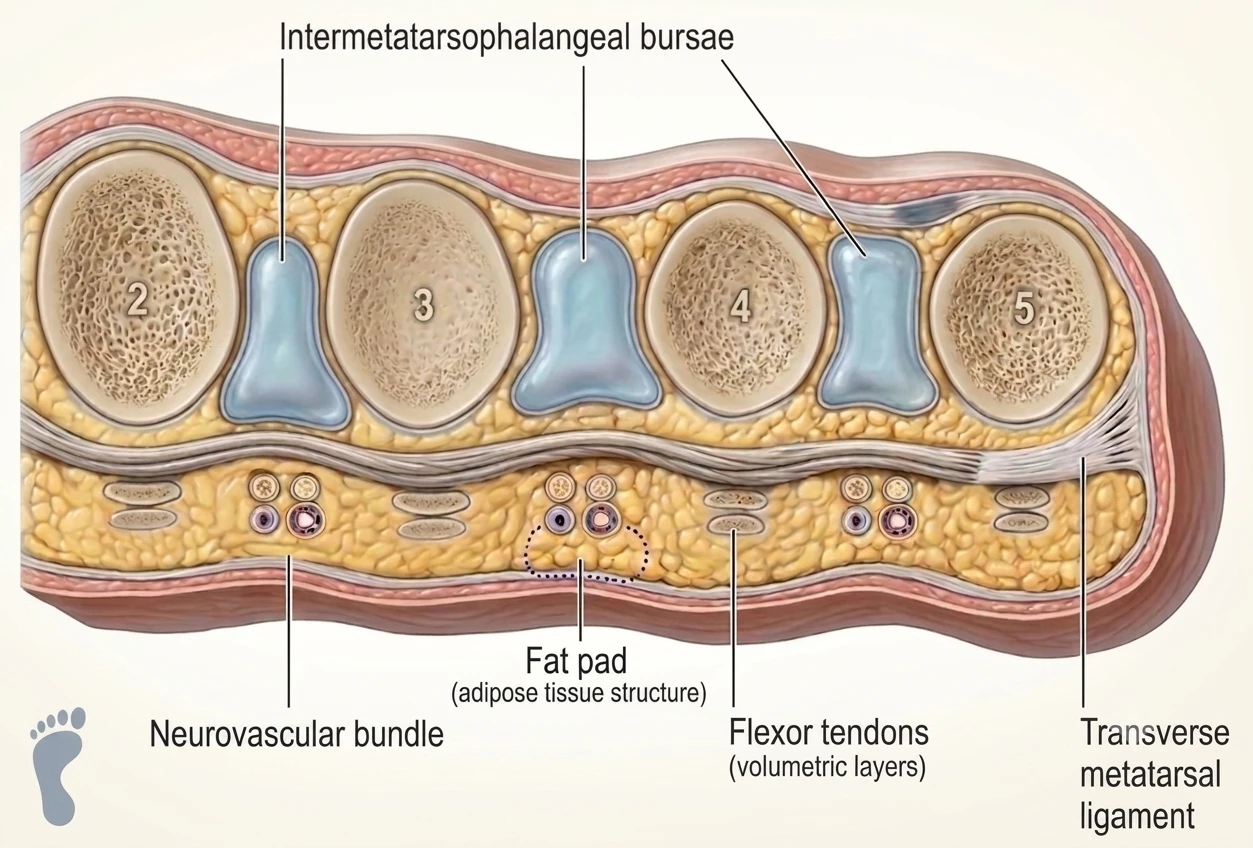
What Happens to the Bursa in Intermetatarsal Bursitis?
A normal intermetatarsal bursa is a thin, small structure that may contain only a minimal amount of fluid and may not be clearly visible on imaging. When the bursa is repeatedly exposed to pressure, friction, or mechanical irritation, it can become inflamed and distended with fluid, making it more prominent.
As the bursa enlarges, it occupies more space between the metatarsal heads and can become painful when compressed during walking or when the forefoot is squeezed by narrow footwear. This may cause localized tenderness, burning, pressure, or pain between the toes.
On ultrasound, a distended intermetatarsal bursa may appear as a fluid-filled or hypoechoic structure between the metatarsal heads. However, the presence of a small amount of fluid alone does not necessarily indicate bursitis. Imaging findings should always be interpreted in the context of the patient’s symptoms and physical examination.
Intermetatarsal bursitis therefore refers to a symptomatic, inflamed or mechanically irritated bursa, rather than simply the presence of fluid within the bursa. The finding is more clinically relevant when the location of the distended bursa corresponds to the patient’s pain and tenderness.
What Causes Intermetatarsal Bursitis?
Intermetatarsal bursitis can develop when a bursa is repeatedly exposed to pressure, friction, or other forms of mechanical irritation. However, mechanical overload is not the only possible cause. Intermetatarsal bursitis can also occur in association with inflammatory rheumatic diseases that affect the joints and surrounding soft tissues of the foot.
Mechanical Irritation and Overuse
Repeated pressure on the forefoot can irritate the intermetatarsal bursa and lead to inflammation and fluid accumulation. This is particularly common in activities that place repetitive stress on the ball of the foot, such as running, jumping, prolonged standing, or walking long distances.
Tight or Narrow Shoes
Shoes with a narrow toe box can compress the metatarsal heads and the soft tissues between them. Repeated compression can irritate an intermetatarsal bursa and aggravate existing inflammation.
High Heels
High-heeled shoes shift more body weight toward the forefoot, increasing pressure beneath the metatarsal heads. When combined with a narrow toe box, this can further increase compression of the intermetatarsal spaces.
Foot Structure and Biomechanics
Certain foot shapes and biomechanical factors can increase pressure on the forefoot and contribute to irritation of the intermetatarsal bursae. These may include altered weight distribution, metatarsal deformities, and other structural abnormalities that increase stress on the ball of the foot.
Inflammatory Rheumatic Diseases
Intermetatarsal bursitis can also occur as part of an inflammatory rheumatic disease. Conditions such as rheumatoid arthritis can cause inflammation not only within the joints but also in surrounding soft tissues, including bursae.
In these cases, bursitis may develop without a clear history of excessive mechanical stress. Multiple areas of the foot may be affected, and other symptoms of inflammatory arthritis may also be present. Identifying an underlying inflammatory condition is important because treatment should address the systemic disease as well as the local symptoms.
Other Causes
Less commonly, inflammation of an intermetatarsal bursa may be associated with trauma, local irritation, or other inflammatory conditions affecting the foot. In some patients, more than one factor may contribute to the development of bursitis—for example, repetitive forefoot loading combined with an underlying inflammatory condition.
Intermetatarsal Bursitis Symptoms
Intermetatarsal bursitis typically causes pain and tenderness in the forefoot, usually between two adjacent metatarsal heads. Symptoms often become worse with activities that place pressure on the ball of the foot.
Common symptoms include:
- Pain between the toes or metatarsal bones
- Tenderness when pressing on the affected area
- Burning, aching, or sharp pain
- A feeling of pressure or fullness in the forefoot
- Pain that worsens with walking, running, or prolonged standing
- Increased discomfort when wearing tight or narrow shoes
- Pain when the forefoot is squeezed from the sides
- A sensation of having a small pebble or foreign object inside the shoe
Symptoms may initially occur only during activity and improve with rest. With continued irritation, pain may become more frequent and occur even during normal walking.
Intermetatarsal bursitis is considered one of the possible causes of metatarsalgia, a general term for pain in the ball of the foot. Because the intermetatarsal bursae lie close to the digital nerves, bursitis can produce symptoms similar to Morton’s neuroma, including burning pain that may extend toward the toes. This overlap can make the two conditions difficult to distinguish based on symptoms alone.
Where Does Intermetatarsal Bursitis Hurt?
Intermetatarsal bursitis causes pain in the forefoot, between two adjacent metatarsal heads, often extending toward the base of the toes. The pain may be localized to one intermetatarsal space or felt more diffusely across the ball of the foot.
Intermetatarsal Bursitis vs Morton’s Neuroma
Intermetatarsal bursitis and Morton’s neuroma can cause very similar symptoms, including pain, burning, and discomfort in the forefoot. However, they affect different structures. Intermetatarsal bursitis involves a bursa between the metatarsal heads, while Morton’s neuroma affects a digital nerve.
| Feature | Intermetatarsal Bursitis | Morton’s Neuroma |
|---|---|---|
| Structure involved | Intermetatarsal bursa | Plantar digital nerve |
| Typical location | Between the metatarsal heads | Most commonly the 3rd–4th interspace |
| Pain | Aching, pressure, tenderness, or burning | Burning, sharp, or shooting |
| Other symptoms | Pressure or fullness between the toes | Tingling, numbness, or “pebble” sensation |
| Ultrasound | Fluid-filled or distended bursa | Enlarged digital nerve or neuroma-like mass |
| Forefoot compression | May reproduce pain | Often reproduces symptoms |
| Relationship to footwear | Often worse with tight shoes | Often worse with tight shoes |
The distinction is not always straightforward. Intermetatarsal bursitis and Morton’s neuroma can occur together, and inflammation or enlargement of the bursa may coexist with irritation of the nearby digital nerve. For this reason, the clinical examination and imaging findings should be interpreted together rather than relying on a single symptom or test.
How Is Intermetatarsal Bursitis Diagnosed?
The diagnosis of intermetatarsal bursitis is based on a combination of the patient’s symptoms, physical examination, and imaging findings.
During the examination, the doctor will assess the location of pain and tenderness and may apply pressure or compress the forefoot to reproduce the symptoms. The clinical presentation is particularly important because intermetatarsal bursitis can resemble Morton’s neuroma and other causes of metatarsalgia.
Ultrasound and MRI can show fluid or distension of an intermetatarsal bursa. However, a small amount of fluid in an intermetatarsal bursa does not necessarily mean that bursitis is causing the patient’s symptoms.
Small amounts of fluid can be seen in asymptomatic individuals, so imaging findings should always be interpreted in correlation with the clinical examination and the location of symptoms.
Ultrasound is particularly useful because it allows dynamic examination of the forefoot and can help distinguish intermetatarsal bursitis from Morton’s neuroma and other causes of forefoot pain. MRI may be useful when the diagnosis remains uncertain or when other conditions need to be excluded.
Treatment Options
Treatment for intermetatarsal bursitis depends on the severity of symptoms and the underlying cause. Most cases can initially be treated conservatively by reducing pressure and irritation of the affected bursa.
Activity Modification
Temporarily reducing activities that aggravate forefoot pain can help reduce irritation and allow the bursa to recover. High-impact activities such as running and jumping may need to be modified temporarily.
Footwear Changes
Shoes with a wide toe box and adequate room around the forefoot can reduce compression of the intermetatarsal space. Tight shoes and high heels should be avoided, particularly when they reproduce symptoms.
Metatarsal Pads and Orthotics
Metatarsal pads and custom or prefabricated orthotics can help redistribute pressure across the forefoot and reduce mechanical stress on the affected bursa.
Pain Relief
Ice and appropriate pain-relieving medication may help control pain during the acute phase. These measures are mainly used to relieve symptoms while the underlying mechanical irritation is addressed.
Physical Therapy
Physical therapy may be useful when altered foot mechanics or excessive forefoot loading contribute to symptoms. Treatment may include exercises and strategies to improve foot function and load distribution.
Corticosteroid Injection
If symptoms persist despite conservative treatment, a corticosteroid injection into the affected bursa may be considered. Ultrasound guidance can help accurately identify the bursa and guide the injection, particularly when the diagnosis or exact location of the symptomatic bursa is uncertain.
Treatment of Underlying Inflammatory Disease
When intermetatarsal bursitis occurs in association with an inflammatory rheumatic disease such as rheumatoid arthritis, treating the underlying disease is an important part of management. Local treatment alone may be insufficient if systemic inflammation remains active.
Most cases improve with conservative treatment. Persistent or recurrent symptoms should prompt reassessment of the diagnosis and consideration of other causes of forefoot pain, including Morton’s neuroma and other causes of metatarsalgia.
Surgery
Surgery is rarely needed for intermetatarsal bursitis. It may be considered in patients with persistent, disabling symptoms that do not respond to appropriate conservative treatment and other less invasive options.
Before surgery, the diagnosis should be carefully confirmed, particularly because intermetatarsal bursitis can coexist with or mimic Morton’s neuroma and other causes of metatarsalgia. When possible, the underlying mechanical or inflammatory cause should also be addressed.
How Long Does Intermetatarsal Bursitis Take to Heal?
The recovery time from intermetatarsal bursitis varies depending on the severity of inflammation and whether the underlying cause is addressed. Mild cases may improve within a few weeks with appropriate footwear, activity modification, and other conservative measures.
More persistent or recurrent cases may take several weeks to a few months to settle, particularly when ongoing mechanical pressure or an underlying inflammatory condition is present. If symptoms do not improve with conservative treatment, further evaluation may be needed to confirm the diagnosis and identify other causes of forefoot pain.
Can Intermetatarsal Bursitis Come Back?
Yes. Intermetatarsal bursitis can recur, particularly if the factors that caused the initial irritation are not addressed. Repeated forefoot pressure, tight footwear, high heels, altered foot mechanics, or an underlying inflammatory condition can all contribute to recurrent symptoms.
How to Prevent Intermetatarsal Bursitis
Preventing intermetatarsal bursitis mainly involves reducing excessive pressure and irritation in the forefoot.
- Wear shoes with a wide toe box and enough room for the forefoot.
- Avoid prolonged use of high heels, especially if they cause forefoot pain.
- Increase running, walking, and other training loads gradually.
- Choose appropriate sports footwear for your activity.
- Consider metatarsal pads or orthotics when recommended to improve pressure distribution.
- Address foot biomechanics and structural factors that may increase forefoot loading.
When Should You See a Doctor?
You should consider seeing a doctor if forefoot pain:
- Persists despite rest and activity modification
- Becomes progressively worse
- Causes significant pain when walking
- Is associated with numbness or tingling
- Is accompanied by noticeable swelling
- Keeps recurring despite appropriate footwear and other measures
- Has an unclear cause or persists between the metatarsal bones
A medical evaluation can help determine whether the symptoms are caused by intermetatarsal bursitis, Morton’s neuroma, metatarsalgia, or another condition.
Frequently Asked Questions
What is intermetatarsal bursitis?
Intermetatarsal bursitis is inflammation and distension of a bursa located between the metatarsal heads in the forefoot. It can cause pain, tenderness, burning, or pressure between the toes.
What causes intermetatarsal bursitis?
It is commonly caused by repeated pressure and irritation of the forefoot, including tight footwear, high heels, and excessive activity. It can also occur in association with inflammatory rheumatic diseases such as rheumatoid arthritis.
Where does intermetatarsal bursitis hurt?
It usually causes pain and tenderness between two adjacent metatarsal heads, often extending toward the base of the toes. Symptoms may be felt in the ball of the foot.
Is intermetatarsal bursitis painful?
Yes. It can cause aching, burning, sharp pain, tenderness, or a sensation of pressure in the forefoot. Symptoms are often worse with walking or tight footwear.
What is the difference between intermetatarsal bursitis and Morton’s neuroma?
Intermetatarsal bursitis affects a bursa, while Morton’s neuroma involves a plantar digital nerve. The two conditions can cause very similar symptoms and may also occur together.
Can shoes cause intermetatarsal bursitis?
Yes. Tight or narrow shoes can compress the intermetatarsal spaces and increase pressure on the bursae. High heels can further increase pressure on the forefoot.
Can intermetatarsal bursitis heal on its own?
Mild cases may improve with rest, activity modification, appropriate footwear, and reduction of forefoot pressure. Persistent symptoms may require further treatment and evaluation.
How long does intermetatarsal bursitis last?
Mild cases may improve within a few weeks, while persistent or recurrent cases can take several weeks to a few months, depending on the underlying cause and treatment.
Can you exercise with intermetatarsal bursitis?
You may be able to continue activities that do not aggravate your symptoms, but high-impact activities such as running and jumping may need to be temporarily reduced or modified.
Does intermetatarsal bursitis require surgery?
Surgery is rarely required. It may be considered only when significant symptoms persist despite appropriate conservative treatment and other less invasive options.
Larsen SB, Offersen CM, Dyrberg E, Johansen JK, Lange NB, Bech BH, Nielsen MB, Torp-Pedersen ST. Morton’s Neuroma or Intermetatarsal Bursitis—A Prospective Diagnostic Study of Intermetatarsal Pain. Diagnostics (Basel). 2025;15(11):1339. Prospective diagnostic study: Intermetatarsal bursitis and Morton’s neuroma
van Dijk BT, Dakkak YJ, Matthijssen XME, Niemantsverdriet E, Reijnierse M, van der Helm-van Mil AHM. Intermetatarsal Bursitis, a Novel Feature of Juxtaarticular Inflammation in Early Rheumatoid Arthritis Related to Clinical Signs: Results of a Longitudinal Magnetic Resonance Imaging Study. Arthritis Care Res (Hoboken). 2022;74(10):1713-1722. MRI study: Intermetatarsal bursitis in early rheumatoid arthritis
Radiopaedia. Intermetatarsal Bursitis. Radiology reference: Imaging features of intermetatarsal bursitis
Larsen SB, Søgaard SB, Nielsen MB, Torp-Pedersen ST. Diagnostic Considerations of Intermetatarsal Bursitis: A Systematic Review. Diagnostics (Basel). 2023;13(2):211. Systematic review: Diagnosis and imaging of intermetatarsal bursitis