
An ankle injury can be painful and swollen whether you have a sprained ankle or a broken bone. Bruising, difficulty walking, and tenderness can occur with both injuries, making it difficult to tell the difference based on symptoms alone.
An ankle sprain occurs when one or more ligaments are stretched or torn, while an ankle fracture means that one of the bones forming the ankle joint is broken. Although some clues can help distinguish them, a fracture cannot always be ruled out simply because you can walk or because the ankle does not look deformed.
So, how can you tell an ankle sprain vs break? The location of tenderness, your ability to bear weight, the mechanism of injury, and specific clinical rules can help determine whether an X-ray is needed.
Key Clinical Points – Ankle Sprain vs Break
- An ankle sprain is an injury to a ligament, while an ankle break is a fracture of one of the ankle bones.
- Swelling, bruising, pain, and difficulty walking can occur with both a sprain and a fracture.
- Being able to walk does not completely rule out an ankle fracture.
- Tenderness directly over the ankle bones is more concerning for a fracture than tenderness over the surrounding soft tissues.
- The Ottawa Ankle Rules can help determine when an X-ray is appropriate after an ankle injury.
Ankle Sprain vs Break: What Is the Difference?
An ankle sprain is an injury to one or more of the ligaments that stabilize the ankle joint. It usually occurs when the ankle twists or rolls beyond its normal range of motion, stretching or tearing the ligament fibers.
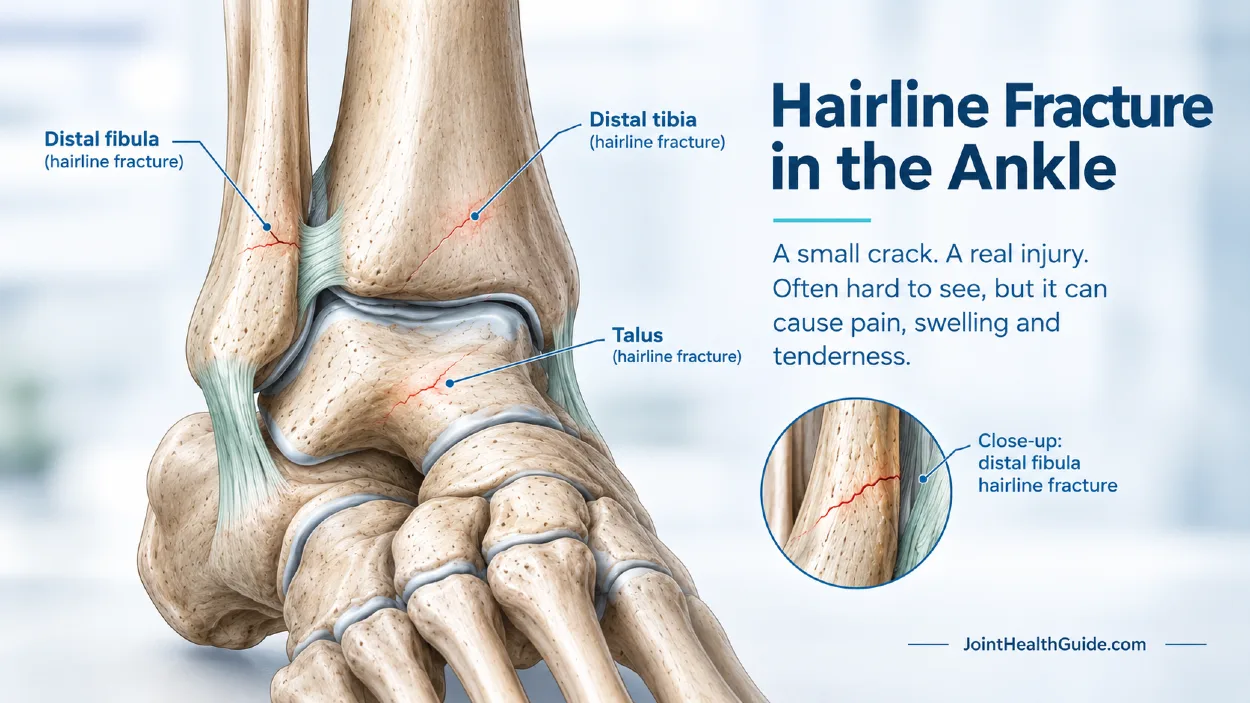
An ankle break, or ankle fracture, is a crack or complete break in one of the bones that form the ankle joint. The most common fractures involve the distal fibula or tibia, although the talus can also be injured.
The problem is that the symptoms of a sprain and fracture can overlap considerably. Both can cause pain, swelling, bruising, tenderness, and difficulty putting weight on the affected foot. Even the severity of pain does not reliably distinguish a sprain from a fracture. A severe sprain can be extremely painful, while some fractures may initially cause relatively mild symptoms.
For this reason, the location of tenderness and the ability to bear weight are often more useful clues than pain intensity alone. In some cases, an X-ray is needed to determine whether a bone is actually broken.
Ankle Sprain vs Break Symptoms
The symptoms of an ankle sprain and ankle fracture can be very similar, which is why it is not always possible to tell them apart based on symptoms alone. The following features can provide useful clues, but a clinical examination and sometimes an X-ray are needed to confirm a fracture.
| Feature | Ankle Sprain | Ankle Fracture |
|---|---|---|
| What is injured? | Ligament | Bone |
| Pain | Common; severity varies | Common; severity varies |
| Swelling | Common | Common |
| Bruising | Common | Common |
| Weight-bearing | May be difficult | May be very difficult or impossible |
| Tenderness | Often over the injured ligament | Often directly over the bone |
| Deformity | Uncommon | May occur with displaced fractures |
| X-ray | Often not needed | Usually needed to confirm the diagnosis |
The most useful distinction is often where the ankle is tender. Pain directly over the bony prominences of the ankle is more concerning for a fracture, while tenderness over the surrounding ligaments is more typical of a sprain. However, these findings can overlap, so they should be interpreted as part of the overall clinical examination.
Can You Walk With an Ankle Sprain or Fracture?
Being able to walk after an ankle injury does not necessarily mean that the ankle is not broken. Some ankle fractures, particularly stable or nondisplaced fractures, may still allow you to put some weight on the affected foot.
Likewise, a severe ankle sprain can make walking extremely painful or even temporarily impossible. The degree of difficulty with weight-bearing therefore cannot reliably distinguish an ankle sprain from a fracture.
If you can walk but have significant tenderness directly over the ankle bones, substantial swelling, or worsening pain, a fracture should still be considered. Clinical examination and, when indicated, an X-ray can help determine whether a broken bone is present.
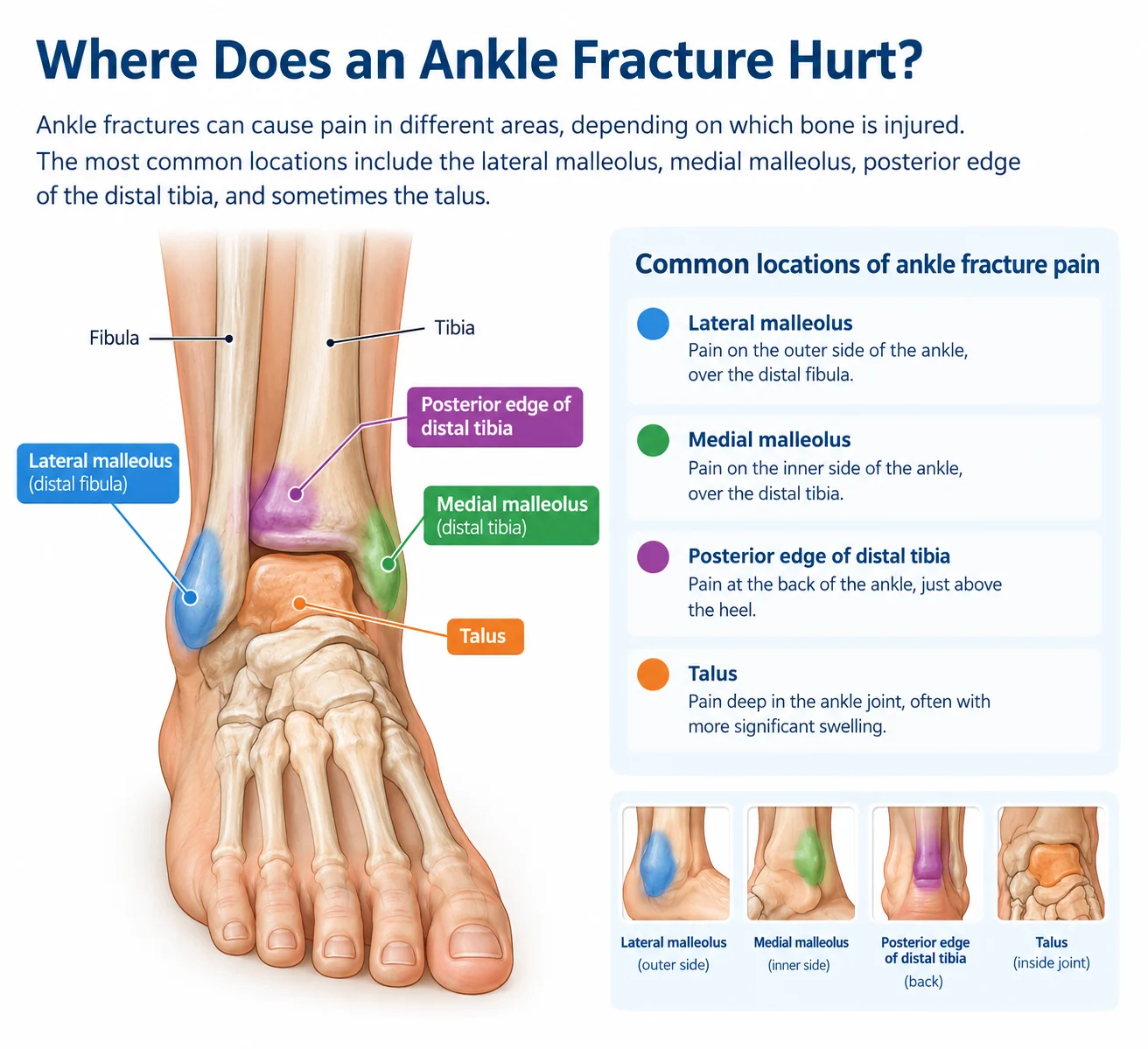
Where Does an Ankle Fracture Hurt?
The location of ankle pain can provide important clues about whether a fracture may be present. Ankle fractures most commonly involve the bony prominences on either side of the ankle, although other bones can also be injured.
- Lateral malleolus: Pain and tenderness on the outer side of the ankle, over the lower end of the fibula.
- Medial malleolus: Pain on the inner side of the ankle, over the lower end of the tibia.
- Posterior edge of the distal tibia: Pain and tenderness at the back of the ankle, just above the heel.
- Talus: Fractures of the talus may cause deeper pain within the ankle joint and can be more difficult to identify based on symptoms alone.
Tenderness directly over these bones is an important finding during a clinical examination. However, pain location alone cannot confirm or exclude a fracture. An X-ray may be necessary when a fracture is suspected.
How Doctors Tell an Ankle Sprain From a Fracture
Doctors cannot always distinguish an ankle sprain from a fracture based on symptoms alone. A clinical examination is the first step in determining which structures are injured and whether further imaging is needed.
During the examination, a doctor assesses the mechanism of injury, swelling, bruising, range of motion, and the exact location of tenderness. Tenderness directly over the ankle bones is particularly important when considering a fracture.
One commonly used clinical decision tool is the Ottawa Ankle Rules. These guidelines help determine whether an X-ray is appropriate after an acute ankle injury. According to the rules, ankle radiographs are generally recommended when there is pain in the malleolar zone combined with bone tenderness over the posterior edge or tip of either malleolus, or an inability to bear weight both immediately after the injury and during the clinical assessment.
The Ottawa Ankle Rules help reduce unnecessary X-rays while maintaining a high sensitivity for clinically significant ankle fractures. However, they are not a substitute for clinical judgment, particularly in patients with severe symptoms, multiple injuries, or other risk factors.
When a fracture is suspected, an X-ray is usually the first imaging test used to confirm the diagnosis. Further imaging, such as CT or MRI, may occasionally be needed depending on the type and location of the injury.
Clinical Insight
One of the most important questions after an ankle injury is whether you can take four steps. Doctors also check for tenderness when pressing directly over the ankle bones. These simple findings help determine whether you may need an X-ray.
Ankle Sprain vs Break: When to See a Doctor
After an ankle injury, it is reasonable to seek medical evaluation if you cannot put weight on the foot, have significant tenderness directly over the ankle bones, or develop substantial swelling or bruising. These findings can occur with both severe sprains and fractures, so they may warrant further assessment and possibly an X-ray.
Seek urgent medical attention if the ankle looks deformed, the foot becomes numb, cold, pale or bluish, or you have severe pain that is rapidly worsening. These symptoms may indicate a more serious injury or impaired circulation.
If you can walk and the pain and swelling are mild, a fracture is less likely, but it cannot always be excluded based on symptoms alone. When in doubt, especially after a significant twisting injury or fall, have the ankle examined by a healthcare professional.
Frequently Asked Questions
Can you walk on a broken ankle?
Yes. Some ankle fractures still allow you to walk, particularly if the fracture is stable or nondisplaced. However, walking can be painful, and being able to bear weight does not rule out a fracture.
Can you walk on a sprained ankle?
Yes. Mild ankle sprains often allow walking, although there may be pain and swelling. More severe sprains can make weight-bearing very difficult or temporarily impossible.
How can you tell if your ankle is broken or sprained?
It is not always possible to tell from symptoms alone. Tenderness directly over the ankle bones, difficulty taking four steps, and certain findings on examination can suggest a fracture. An X-ray may be needed to confirm it.
Does a sprained ankle hurt more than a fracture?
Not necessarily. Pain intensity does not reliably distinguish a sprain from a fracture. A severe sprain can be extremely painful, while some fractures may initially cause relatively mild pain.
Do all ankle fractures need a cast?
No. Not all ankle fractures require a traditional cast. Treatment depends on the type, location, stability, and displacement of the fracture. Some stable fractures can be treated with a walking boot or other immobilization, while unstable fractures may require surgery.
Stiell IG et al. Decision rules for the use of radiography in acute ankle injuries. Refinement and prospective validation. JAMA. 1993;269(9):1127-1132. PubMed: Ottawa Ankle Rules development and prospective validation
Bachmann LM et al. Accuracy of Ottawa ankle rules to exclude fractures of the ankle and mid-foot: systematic review. BMJ. 2003;326:417. PubMed: Systematic review of Ottawa Ankle Rules accuracy
Beckenkamp PR et al. Diagnostic accuracy of the Ottawa Ankle and Midfoot Rules: a systematic review with meta-analysis. Br J Sports Med. 2017;51(6):504-510. PubMed: Meta-analysis of Ottawa Ankle and Midfoot Rules
Keogh J et al. Diagnostic accuracy of the Ottawa ankle rule to exclude fractures in acute ankle injuries in adults: a systematic review and meta-analysis. PubMed: Diagnostic accuracy of the Ottawa Ankle Rule in adults
American College of Radiology. ACR Appropriateness Criteria®: Acute Trauma to the Ankle. ACR clinical guideline: Imaging after acute ankle trauma
Jonckheer P et al. Evaluating fracture risk in acute ankle sprains: Any news since the Ottawa Ankle Rules? A systematic review. Eur J Gen Pract. 2016;22(1):31-41. PubMed: Systematic review of fracture risk after ankle sprain
Stiell I. Ottawa ankle rules. Can Fam Physician. 1996;42:478-480. PubMed: Ottawa Ankle Rules clinical guide