
Although diastasis recti is most commonly associated with pregnancy and the postpartum period, it can also affect men. In fact, obese men represent the second most commonly affected group, as excess abdominal fat and chronically increased intra-abdominal pressure place continuous stress on the connective tissue between the abdominal muscles.
Instead of a muscle tear, diastasis recti is a widening of the linea alba—the connective tissue that joins the left and right rectus abdominis (“six-pack”) muscles. As the tissue stretches, the muscles gradually separate, often causing a visible bulge or ridge along the middle of the abdomen, especially when sitting up, coughing, or lifting heavy objects.
Many men mistake this bulge for excess fat or an abdominal hernia. Although diastasis recti itself is not dangerous, it may contribute to reduced core strength, lower back pain, poor trunk stability, and difficulty performing physical activities.
The good news is that most men improve with targeted rehabilitation, weight reduction when appropriate, and progressive core strengthening. In this article, we’ll explain what causes diastasis recti in men, how to recognize the symptoms, how it differs from an abdominal hernia, and which treatments and exercises are most effective.
Key Clinical Points – Diastasis Recti in Men
- Diastasis recti in men is a widening of the linea alba, the connective tissue between the rectus abdominis (“six-pack”) muscles, rather than a tear of the abdominal muscles.
- The condition is often associated with obesity, increased abdominal pressure, heavy straining, aging-related connective tissue changes, and previous abdominal surgery.
- The most common sign is a midline abdominal bulge that becomes more visible during movements such as sitting up, coughing, lifting, or performing abdominal exercises.
- Diastasis recti is different from an abdominal hernia because it involves stretching of connective tissue rather than a defect or opening in the abdominal wall.
- Diagnosis is usually made through physical examination, with ultrasound used in some cases to measure the separation and assess abdominal wall function.
- Treatment is mainly conservative and focuses on weight management, core rehabilitation, and improving abdominal wall control. Surgery is rarely required.
What Is Diastasis Recti in Men?
Diastasis recti in men is a condition in which the left and right sides of the rectus abdominis (“six-pack”) muscles become separated because the linea alba—the connective tissue running along the middle of the abdomen—stretches and widens.
Despite the term “muscle separation,” diastasis recti is not a tear of the abdominal muscles. The muscles remain intact; the main change occurs in the connective tissue between them. When the linea alba becomes thinner and less tension-resistant, it may allow the abdominal wall to protrude forward, creating a visible bulge along the midline.
Although diastasis recti is strongly associated with pregnancy, it can also occur in men. In males, the condition is often related to factors that place prolonged stress on the abdominal wall, such as increased abdominal pressure, excess body weight, heavy lifting, or changes in connective tissue strength over time.
The most noticeable sign is a midline abdominal bulge or ridge, which may become more visible when performing movements that increase pressure inside the abdomen, such as sitting up, coughing, or lifting. Some men may also experience core weakness, reduced trunk stability, lower back discomfort, or difficulty controlling abdominal movements.
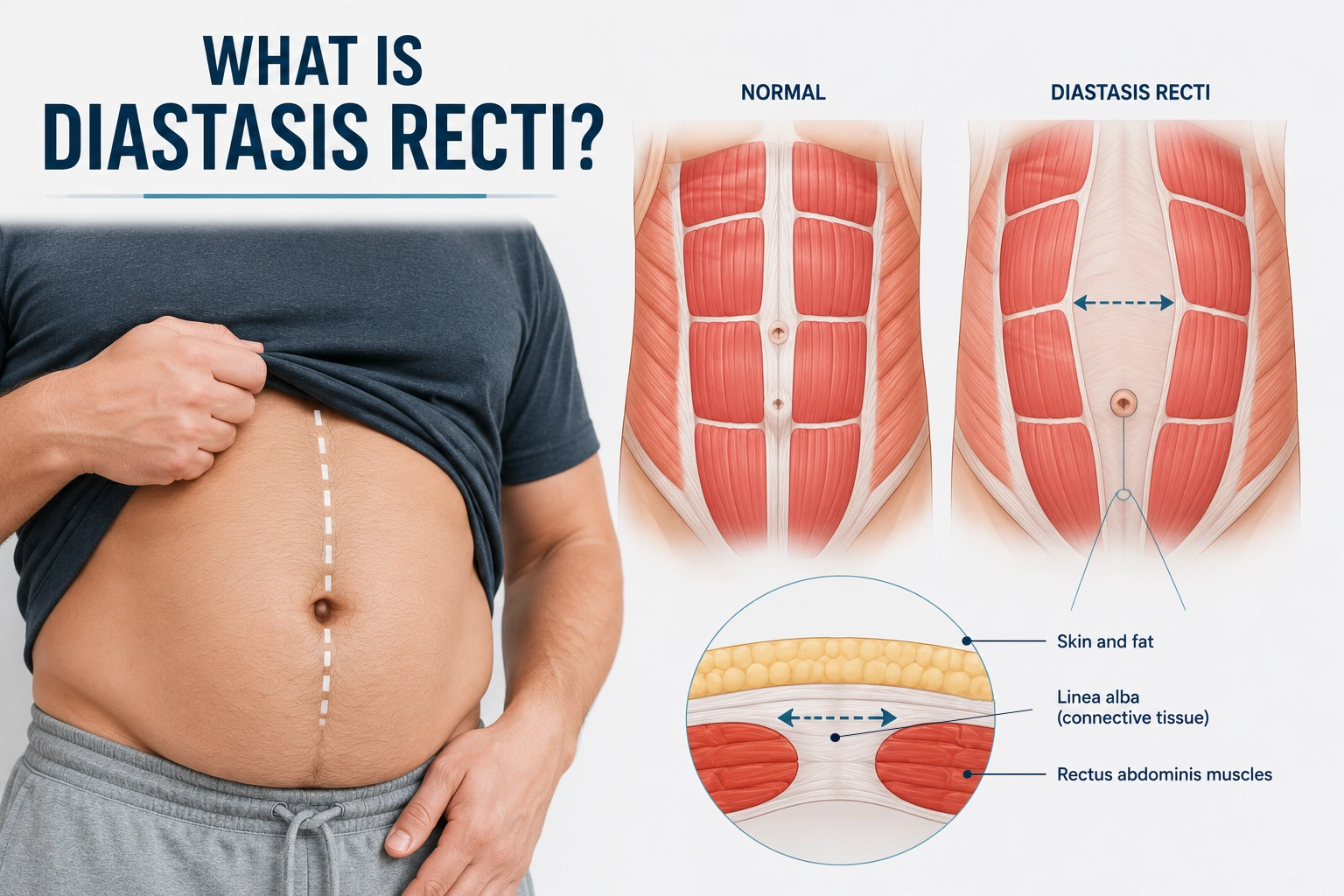
Because a visible abdominal bulge can also occur with an abdominal hernia, many men confuse these two conditions. While diastasis recti and hernias are different problems, they can sometimes exist together, making proper evaluation important.
In the next sections, we will explain why diastasis recti develops in men, who is most at risk, how to recognize the symptoms, and which treatment options and exercises can help improve abdominal function.
Anatomy of the Abdominal Wall
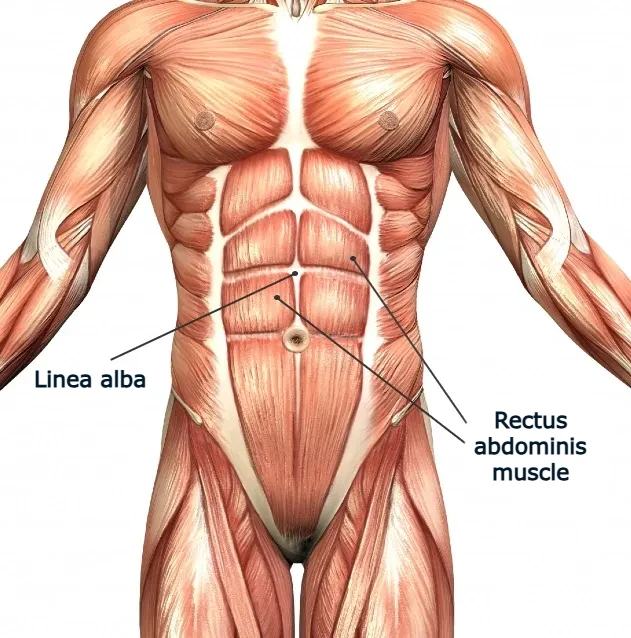
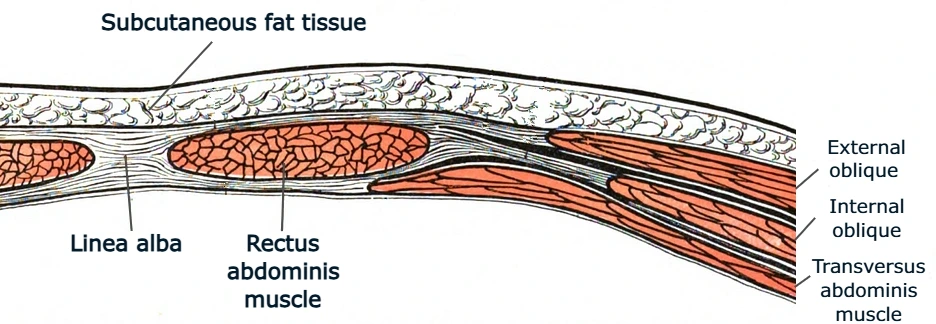
To understand diastasis recti in men, it is important to know the role of two main structures: the rectus abdominis muscles and the linea alba.
Rectus Abdominis
The rectus abdominis muscles are the paired muscles located on the front of the abdomen, commonly known as the “six-pack” muscles. They help with trunk movement, posture, and stabilization of the spine during everyday activities and physical exercise.
The left and right rectus abdominis muscles are normally positioned close together and connected by a band of connective tissue called the linea alba.
Linea Alba
The linea alba is a strong strip of connective tissue that runs vertically down the middle of the abdomen, connecting the abdominal muscles on both sides.
Its role is to transfer forces between the left and right sides of the abdominal wall and help maintain abdominal stability.
In diastasis recti, the linea alba becomes stretched and widened. As a result, the rectus abdominis muscles move farther apart, which may lead to a visible bulge along the middle of the abdomen, especially when pressure inside the abdomen increases.
What Causes Diastasis Recti in Men?
Diastasis recti develops when the linea alba, the connective tissue between the two rectus abdominis muscles, becomes stretched and widened over time. The main mechanism behind this process is repeated or prolonged increases in intra-abdominal pressure combined with reduced ability of the abdominal wall to resist this stress.
Several factors can contribute to the development of diastasis recti in men.
1. Obesity and Visceral Fat
Excess body weight, especially increased abdominal fat, is one of the most common factors associated with diastasis recti in men.
A larger abdomen places continuous outward pressure on the abdominal wall. Over time, this increased mechanical stress can stretch the linea alba and reduce the ability of the abdominal muscles to work together efficiently.
Men with significant visceral fat (fat stored around internal organs) may be at higher risk because it increases abdominal volume and contributes to chronically elevated pressure inside the abdomen.
Did You know?
Research suggests that a larger waist circumference is associated with a greater risk of abdominal muscle separation. In one study, a waist measurement above approximately 102 cm was linked to a higher likelihood of increased distance between the rectus abdominis muscles. For each additional centimeter above this threshold, the separation increased further.
Weight reduction can therefore be an important part of treatment, as reducing abdominal pressure may improve symptoms and make rehabilitation more effective.
2. Heavy Lifting and Weight Training
Heavy lifting does not automatically cause diastasis recti. Many men perform strength training without developing any problems.
However, activities that repeatedly generate very high intra-abdominal pressure may place additional stress on the abdominal wall. This is especially relevant when heavy exercises are performed with poor breathing technique, excessive straining, or inadequate core control.
Movements such as heavy squats, deadlifts, or overhead presses may temporarily increase abdominal pressure. In most healthy individuals, the abdominal wall adapts to these demands, but repeated excessive loading may contribute to problems in susceptible men.
3. Chronic Increased Intra-Abdominal Pressure
Any condition that repeatedly increases pressure inside the abdomen may contribute to stretching of the linea alba.
Examples include:
- chronic coughing (such as in smokers or people with lung disease)
- frequent constipation and straining during bowel movements
- repeated heavy physical work
- activities involving frequent forceful pushing or bracing
The key factor is not a single episode of increased pressure, but repeated stress over time.
4. Aging and Connective Tissue Changes
The strength and elasticity of connective tissues change with age. The collagen fibers that make up the linea alba may become less resilient, making the abdominal wall more vulnerable to stretching.
Older men may therefore develop diastasis recti even without a history of major weight gain or intense physical activity, especially if other risk factors are present.
5. Previous Abdominal Surgery
Abdominal surgery can sometimes affect the structure and function of the abdominal wall.
Surgical procedures involving an incision through the midline of the abdomen may alter the normal arrangement of connective tissues and muscles. In some cases, this may contribute to weakness or changes in abdominal wall mechanics.
However, previous surgery is only one possible factor and does not mean that diastasis recti will necessarily develop.
Key point: Diastasis recti in men is usually not caused by a single event. It develops gradually when repeated stress and increased pressure on the abdominal wall exceed the ability of the connective tissue to maintain normal tension.
Who Is More Likely to Develop Diastasis Recti?
Although diastasis recti can affect men of different ages and body types, it is more commonly seen in men who have factors that increase stress on the abdominal wall or reduce the strength of connective tissues over time.
Men who may be at higher risk include:
- Men with obesity or increased abdominal fat – Excess abdominal weight increases pressure on the abdominal wall and may gradually stretch the linea alba.
- Strength athletes and men who perform heavy lifting – Repeated high-pressure movements, especially when combined with poor breathing technique or excessive straining, may increase stress on the abdominal wall.
- Men with chronic coughing or constipation – Frequent coughing or repeated straining during bowel movements can cause repeated increases in intra-abdominal pressure.
- Older men – Age-related changes in collagen and connective tissue elasticity may make the linea alba less resistant to stretching.
- Men after abdominal surgery – Previous procedures involving the abdominal wall may alter normal tissue mechanics and contribute to weakness in some individuals.
Having one of these risk factors does not mean that a man will definitely develop diastasis recti. The condition usually develops gradually when repeated stress on the abdominal wall exceeds the ability of the connective tissue to maintain normal tension.
Diastasis Recti Symptoms in Men
The symptoms of diastasis recti in men vary depending on the degree of abdominal separation and the function of the surrounding core muscles. Some men notice only a change in the appearance of their abdomen, while others experience reduced core strength or difficulty with physical activities.
Midline abdominal bulge
The most common sign of diastasis recti is a visible bulge or ridge running along the middle of the abdomen. It often becomes more noticeable when sitting up, coughing, lifting, or performing exercises that increase abdominal pressure.
Doming during abdominal exercises
Some men notice a dome-shaped bulge or “coning” along the center of the abdomen during sit-ups, crunches, or other core exercises. This occurs when pressure inside the abdomen pushes outward through the stretched linea alba.
Core weakness and reduced stability
Because the abdominal muscles help stabilize the spine and control movement, diastasis recti may contribute to a feeling of reduced core strength or poor trunk control during exercise and daily activities.
Lower back discomfort
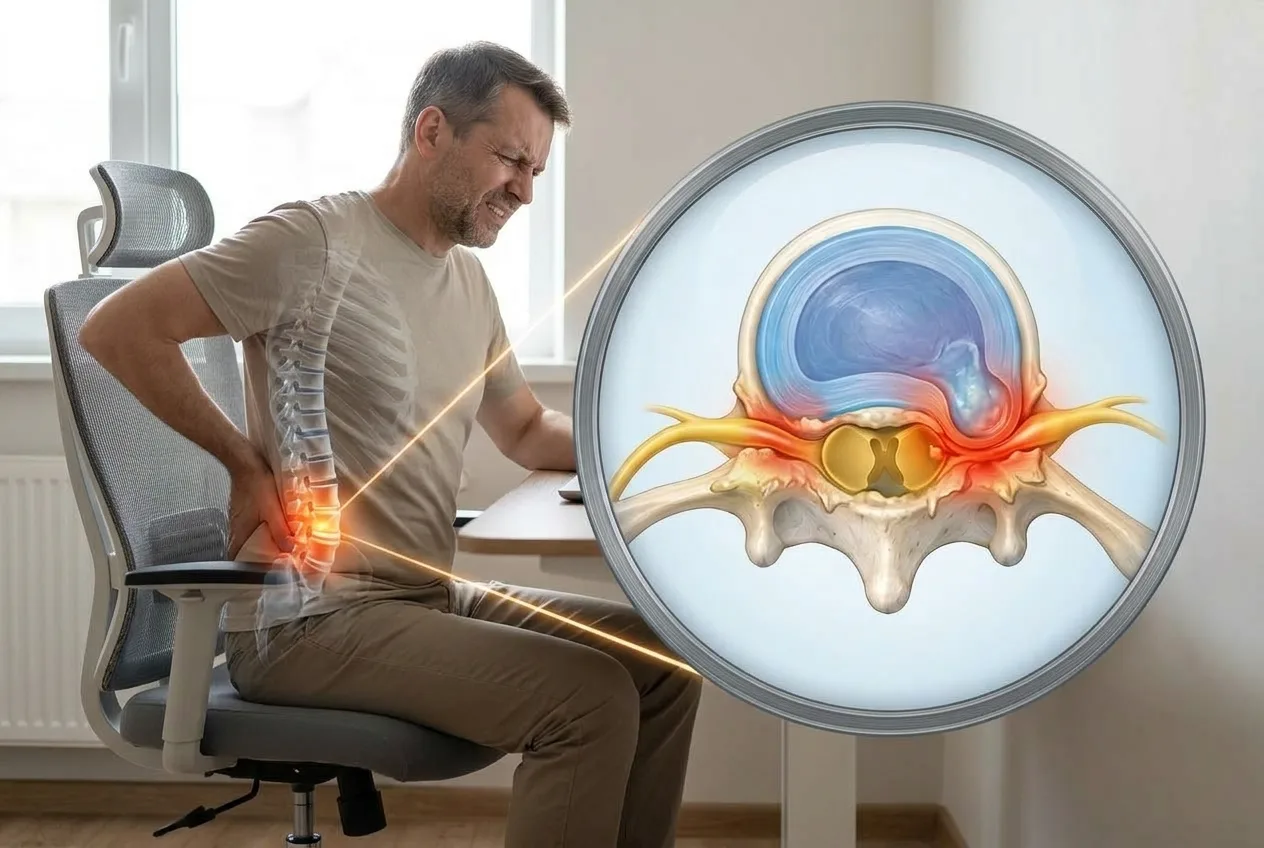
In some men, reduced abdominal wall function may contribute to lower back discomfort by affecting spinal stability. However, back pain is not specific to diastasis recti and can have many other causes.
Cosmetic concerns
Many men seek evaluation because of a persistent abdominal bulge that does not improve despite weight loss or regular exercise. The appearance of the abdomen is often the first reason they notice the condition.
Diastasis Recti vs Hernia
Because both conditions can cause a visible bulge in the abdomen, diastasis recti is often confused with an abdominal hernia. However, they are different problems that involve different structures.
Key differences: Diastasis recti is a widening of the linea alba, the connective tissue between the rectus abdominis muscles. It does not involve a hole or defect in the abdominal wall. A hernia, on the other hand, occurs when tissue or an organ pushes through a weakened area or opening in the abdominal wall.
A diastasis recti bulge is usually wider and appears along the middle of the abdomen, especially during movements that increase abdominal pressure. A hernia often appears as a more localized lump that may become more prominent with coughing, straining, or standing.
Can they occur together?
Yes. Diastasis recti and abdominal hernias can occur at the same time. The stretching and weakening of the abdominal wall in some individuals may increase the risk of developing certain types of hernias.
When to seek medical evaluation
Most cases of diastasis recti are not dangerous and can be managed with rehabilitation and lifestyle changes. However, a new, painful, rapidly enlarging, or firm abdominal bulge should be evaluated by a healthcare professional to rule out a hernia or another condition.
How Is Diastasis Recti Diagnosed in Men?
Diastasis recti in men is usually diagnosed through a physical examination. A healthcare professional, such as a physiatrist or physical therapist, can assess whether abdominal separation is present, where it is located, and how it affects abdominal wall function.
During the examination, the clinician evaluates the tension and movement of the abdominal wall and measures the distance between the two sides of the rectus abdominis muscles, known as the inter-recti distance (IRD). The separation can occur above the belly button, at the level of the belly button, or below it.
A simple clinical assessment can often be performed by gently palpating the middle of the abdomen while the patient activates the abdominal muscles, for example by slightly lifting the head and shoulders from a lying position. The distance may be estimated clinically or measured more precisely using tools such as calipers or ultrasound.
A separation of more than approximately 2 cm is commonly used as a clinical reference point for diastasis recti. However, the size of the gap alone does not determine the severity of the condition. The tension of the linea alba, abdominal wall function, and the presence of symptoms are also important.
In some cases, ultrasound imaging can be used to measure the linea alba more accurately and assess abdominal wall function. Other imaging tests, such as CT or MRI, are rarely needed unless another condition, such as an abdominal hernia, is suspected.
Diastasis Recti Treatment in Men
Treatment for diastasis recti in men depends on the severity of abdominal separation, symptoms, body composition, and functional limitations. In most cases, treatment is conservative and focuses on improving abdominal wall function, reducing excessive pressure on the linea alba, and strengthening the core muscles in a controlled way.
Unlike an abdominal hernia, diastasis recti usually does not require surgery because there is no actual defect or hole in the abdominal wall. Many men improve with a combination of weight management, targeted rehabilitation, and gradual return to physical activity.
Weight Loss
For men with excess abdominal fat, weight reduction can be an important part of treatment. Decreasing abdominal volume reduces pressure on the abdominal wall and may improve the ability of the core muscles to function more effectively.
Weight loss alone may not completely close the separation, but it can reduce abdominal bulging and improve the results of rehabilitation.
Physical Therapy and Core Rehabilitation
Targeted rehabilitation is the main treatment approach for symptomatic diastasis recti. The goal is not simply to “close the gap” but to improve the coordination and function of the entire abdominal wall.
A physical therapist can help develop exercises that improve core control, breathing patterns, and the ability to manage pressure during daily activities and exercise.
Abdominal Binder
An abdominal binder may provide temporary support and improve comfort in some individuals, especially during activities that increase abdominal pressure.
However, binders do not strengthen the abdominal muscles or permanently correct diastasis recti. They are usually considered an additional support rather than a primary treatment.
Surgery
Surgery is rarely needed for diastasis recti alone. It may be considered in selected cases with severe functional impairment, significant cosmetic concerns, or when diastasis recti is associated with an abdominal hernia.
Surgical options usually involve tightening or repairing the abdominal wall, but the decision should be individualized after evaluation by an appropriate specialist.
Exercises for Diastasis Recti in Men
Exercise is an important part of conservative treatment for diastasis recti. The goal of rehabilitation is not simply to close the gap between the abdominal muscles, but to improve abdominal wall function, core stability, and the ability to control pressure during movement.
A rehabilitation program usually focuses on deep core activation, breathing control, and gradual strengthening of the abdominal muscles. Commonly recommended exercises may include dead bug, heel slides, bird dog, modified planks, side planks, and Pallof press.
However, some exercises may place excessive stress on the linea alba, especially if they cause visible abdominal doming or poor control of the abdominal wall.
Exercises that may need to be modified or avoided include:
- Traditional sit-ups and aggressive crunches – These movements can significantly increase pressure inside the abdomen and may worsen abdominal doming in some individuals.
- Heavy lifting with poor bracing technique – Strength training is not necessarily harmful, but lifting heavy loads without proper breathing and core control can place excessive stress on the abdominal wall.
- Any exercise that causes abdominal doming or coning – Visible bulging along the midline during an exercise is a sign that the movement may be too demanding and should be modified.
The best exercise approach is individualized and should gradually progress as abdominal control improves.
Can Diastasis Recti Be Prevented?
Preventing diastasis recti is not always possible because factors such as genetics, aging, and connective tissue strength also play a role. However, maintaining a healthy body weight, avoiding excessive abdominal strain, using proper lifting techniques, and gradually progressing with core exercises may help reduce stress on the abdominal wall.
For men who perform heavy strength training, proper breathing and bracing technique are especially important to avoid unnecessary increases in intra-abdominal pressure.
Prognosis
The outlook for men with diastasis recti is generally good. Many men can improve abdominal function, core stability, and the appearance of the abdomen with appropriate rehabilitation and lifestyle changes.
The goal of treatment is not always to completely eliminate the separation, but to restore effective abdominal wall function and reduce symptoms. Results depend on factors such as the size of the separation, duration of the condition, body weight, and consistency with rehabilitation.
Frequently Asked Questions
Can men get diastasis recti?
Yes. Although diastasis recti is most commonly associated with pregnancy, it can also affect men. In men, it is often linked to factors such as obesity, increased abdominal pressure, heavy lifting, and changes in connective tissue strength.
What does diastasis recti look like in men?
Diastasis recti typically appears as a bulge or ridge along the middle of the abdomen, especially when sitting up, coughing, lifting, or performing abdominal exercises.
Is diastasis recti the same as a hernia?
No. Diastasis recti involves stretching and widening of the linea alba, while a hernia occurs when tissue pushes through a weakness or opening in the abdominal wall. However, both conditions can occur together.
Can obesity cause diastasis recti?
Obesity, especially increased abdominal and visceral fat, is an important risk factor because it creates prolonged pressure on the abdominal wall and may stretch the linea alba over time.
Can weightlifting cause diastasis recti?
Weightlifting does not automatically cause diastasis recti. However, repeated heavy straining, poor breathing technique, and excessive abdominal pressure may contribute to its development in susceptible individuals.
Can exercise fix diastasis recti in men?
Targeted exercise can improve core strength, abdominal control, and symptoms. However, the goal is usually to restore function rather than simply close the gap completely.
Is surgery necessary?
Most men do not need surgery. Surgical treatment is usually reserved for selected cases with severe symptoms, major functional limitations, or associated abdominal hernia.
How long does recovery take?
Recovery varies depending on the severity of the condition, consistency with rehabilitation, and individual factors. Improvement often occurs gradually over several months.
Can you build six-pack abs with diastasis recti?
Yes, many men can continue strength training and develop abdominal muscles. However, exercises may need to be modified to avoid excessive abdominal pressure and doming.
Will losing weight close the abdominal gap?
Weight loss can reduce abdominal pressure and improve the appearance of the abdomen, but it does not always completely close the separation. Combining weight reduction with targeted rehabilitation usually provides the best results.
Can diastasis recti come back after treatment?
Yes, recurrence is possible, especially if the factors that contributed to the condition persist. Maintaining core strength, healthy body weight, and proper exercise technique can help reduce the risk.
Nienhuijs S, Wijgers R, Schipper E, Reilingh TV, Wegdam J. Rectus diastasis in males: a narrative review. Hernia. 2025;29(1):212. Springer: Narrative review of rectus diastasis in men, causes, diagnosis, and management
Henriksen NA et al. Rectusdiastase hos mænd [Rectus diastasis in men]. Ugeskr Laeger. 2025;187(37):V04250320. Clinical review: Rectus diastasis in male patients
Hall H, Sanjaghsaz H. Diastasis Recti Rehabilitation. StatPearls. Updated 2023 Aug 8. NCBI Bookshelf: Evidence-based overview of diastasis recti rehabilitation
Axelsen KH, Diasso P, Christoffersen MW, Henriksen NA. Diastasis recti in male patients: a literature review and proposed management. Hernia. 2026;30(1):87. Hernia journal: Review of male diastasis recti and management strategies
Nienhuijs SW, Berkvens EHM, de Vries Reilingh TS, Mommers EHH, Bouvy ND, Wegdam J. The male rectus diastasis: a different concept? Hernia. 2021;25(4):951-956. Hernia journal: Review of male rectus diastasis as a distinct clinical entity
Lockwood T. Rectus muscle diastasis in males: primary indication for endoscopically assisted abdominoplasty. Plastic and Reconstructive Surgery. 1998;101(6):1685-1691. Plastic and Reconstructive Surgery: Surgical management of rectus diastasis in men