
A ganglion cyst is a benign, fluid‑filled sac that most often appears on the wrist. It can also develop on other parts of the hand, the knee, or the ankle. It usually appears as a firm lump on the wrist and may change size over time. Some people call it a “biblical cyst” because of the old practice of hitting it with a heavy book to “burst” it — a method that is no longer recommended.
A ganglion cyst is benign, not dangerous, and often painless. However, it can cause discomfort, pressure, or weakness when it presses on nearby nerves or tendons. Many patients seek medical advice because they notice a lump on the wrist or a bump on the wrist that suddenly appears.
In this article, we explain what a ganglion cyst is, why it forms, how it causes symptoms, and which treatment options offer the best long‑term results.
Key Clinical Points – Ganglion Cyst (Biblical Cyst)
- Ganglion cysts are the most common benign soft‑tissue masses of the wrist and hand, often painless but sometimes causing discomfort or weakness.
- Clinically appear as a firm, well‑defined lump on the dorsal or volar wrist, filled with thick mucinous fluid.
- Diagnosis is primarily clinical; transillumination and ultrasound help distinguish cysts from solid or vascular masses.
- About 50% resolve spontaneously within 1–2 years, making observation appropriate for asymptomatic cases.
- Aspiration offers short‑term relief but has a high recurrence rate (≈50%).
- Surgical excision removes the cyst and its stalk, providing the lowest recurrence rate (≈10%).
- The nickname “biblical cyst” comes from the historical practice of striking the cyst with a heavy book, a method no longer recommended.
What is a Ganglion Cyst?
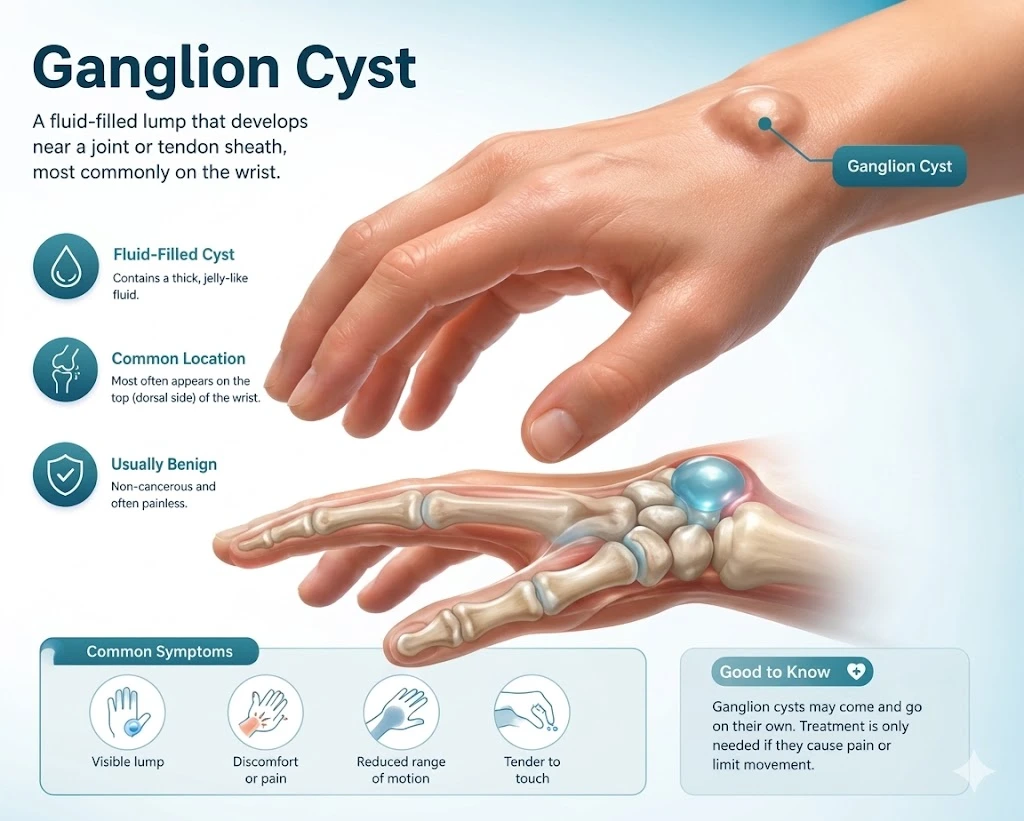
A ganglion cyst is a benign, mucin‑filled mass that forms near a joint or a tendon sheath. It most commonly appears on the dorsal (back) side of the wrist, but it can also develop on the volar (palm) side, around the finger joints, the ankle, or the foot. The cyst contains a thick, gelatinous fluid rich in hyaluronic acid and mucopolysaccharides, which gives it its characteristic viscous texture.
Ganglion cysts often connect to the joint or tendon sheath through a thin stalk, allowing fluid to move in and out. Under the microscope, a ganglion cyst does not have a true epithelial lining. Instead, it consists of layers of collagen fibers with scattered fibroblasts. Although harmless, the cyst can become bothersome due to its size or pressure on nearby structures.
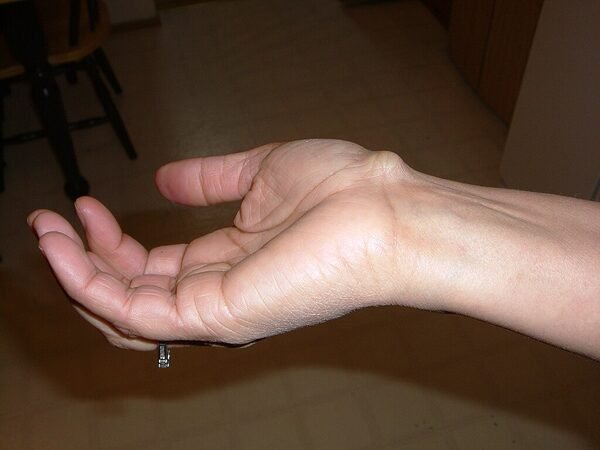
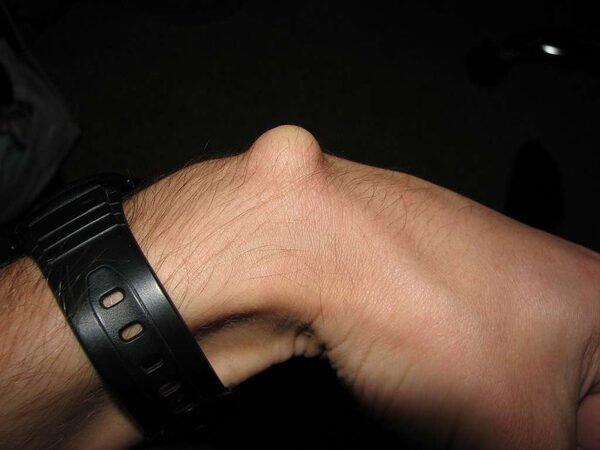
Clinically, it appears as a firm, well‑defined lump on the wrist or another joint area. Many patients describe it simply as a bump on the wrist.
Why it is Sometimes Called a “Biblical Cyst”
The term “biblical cyst” comes from an old folk remedy in which people tried to burst a ganglion cyst by hitting it with a heavy book, often a Bible because it was the heaviest book in the house. The idea was that a strong blow would rupture the cyst wall and force the fluid to disperse into surrounding tissues. Although this method became culturally well‑known, it is not recommended today because it can cause injury, bruising, or damage to nearby structures.
What Causes a Ganglion Cyst
The exact cause of a ganglion cyst is still not fully understood, but several modern theories explain how and why it forms.
Older explanations suggested that a ganglion develops when the joint capsule bulges outward and fills with fluid. Today we know this is unlikely, because the cyst wall is not the same as the joint capsule, and the fluid inside the cyst has a different biochemical composition than normal synovial fluid.
Current research supports a different mechanism. According to modern theories, a ganglion cyst forms when cells near the joint capsule or tendon sheath respond to repetitive micro‑injuries and chronic mechanical stress. These small, repeated stresses trigger changes in the surrounding connective tissue. The tissue begins to produce thick, gelatinous mucin, rich in hyaluronic acid and mucopolysaccharides. This fluid gradually accumulates and forms a cyst, which becomes visible as a lump or bump under the skin.
In many cases, the cyst remains connected to the joint or tendon sheath through a thin stalk, allowing fluid to move in one direction and contributing to the cyst’s tendency to fluctuate in size.
How Common are Ganglion Cysts?
Ganglion cysts are the most frequent soft‑tissue masses found on the wrist and hand. They show a clear demographic pattern and appear more often in certain populations.
- 60–70% of all soft‑tissue masses in the hand and wrist are ganglion cysts
- Most common in women aged 20–50
- Women are three times more likely to develop a ganglion cyst than men
- Higher prevalence in gymnasts
Symptoms of a Ganglion Cyst
Most ganglion cysts are asymptomatic, meaning they cause no pain or functional problems. Many patients seek medical attention simply because they notice a visible lump or bump on the wrist and are concerned about its appearance. A typical ganglion cyst looks like a smooth, round swelling measuring 1–2 cm and feels like a firm, rubbery ball under the skin. It is partially mobile because it is attached to the joint capsule or tendon sheath, but it is not attached to the skin above it.
When symptoms do occur, they may include:
- Wrist or hand pain that may radiate up the arm
- Pain during activity or pressure on the cyst
- Reduced wrist range of motion or decreased grip strength
Patients with ganglion cysts on the volar (palm‑side) aspect of the wrist may occasionally develop carpal tunnel–like symptoms due to pressure on the median nerve. A trigger finger can also occur when the cyst compresses the flexor tendon sheath.
In very rare cases, a ganglion cyst may compress the ulnar nerve in the wrist or even the radial artery.
Diagnosis
The diagnosis of a ganglion cyst is usually made clinically, based on the patient’s history and physical examination. Because the cyst is filled with fluid, it is translucent. When illuminated with a flashlight, light passes through the cyst — a feature that helps distinguish it from solid tumors.
A standard X‑ray does not show a ganglion cyst, but it is useful for ruling out other conditions such as wrist arthritis or bone tumors.
MRI is rarely needed and is reserved for cases where there is concern that the mass may not be a typical ganglion cyst.
Ultrasound is highly effective for visualizing the size and location of the cyst and can sometimes identify its connection to deeper structures. It also helps differentiate a ganglion cyst from other soft‑tissue masses or vascular malformations. During needle aspiration, ultrasound guidance is valuable because it helps avoid accidental puncture of the radial artery.
Other Possible Causes of a Lump on the Wrist
When a patient notices a lump or bump on the wrist, a ganglion cyst is the most common diagnosis — but several other, usually benign, conditions can present with a similar mass. These should be considered in the differential diagnosis.
- Giant Cell Tumor of the Tendon Sheath — A benign synovial‑origin tumor most common in adults aged 30–50. It occurs slightly more often in women and is more frequently found on the fingers than on the wrist. It is the second most common mass in the hand after ganglion cysts.
- Hemangioma — A benign soft‑tissue tumor composed of a network of blood vessels mixed with thrombi, fat, fibrous tissue, or muscle. Skin discoloration or a visible vascular anomaly is often present above the lesion.
- Lipoma — A benign tumor of fatty tissue. Typically superficial, often located at the base of the thumb (thenar region) or in the central palm.
- Schwannoma — A benign tumor arising from the sheath of peripheral nerves. Patients usually present with a visible mass that is rarely painful.
Treatment of a Ganglion Cyst
Patients seek treatment for a ganglion cyst for several different reasons. About one‑third are bothered primarily by the cosmetic appearance of the lump on the wrist. Another third seek help because of pain or limited wrist motion. Around one‑quarter of patients are worried that the mass might be malignant. It is important to emphasize that a ganglion cyst is not cancerous, and there is no risk of malignant transformation.
Clinical experience shows that almost half of all ganglion cysts resolve spontaneously within 1–2 years of appearing.
If the cyst does not cause pain or interfere with daily activities, the recommended approach is observation, with periodic follow‑up to monitor changes in size or the development of symptoms.
Only cysts that cause symptoms or significant cosmetic concern require treatment. Management options include conservative care, needle aspiration with or without corticosteroid injection, and surgical removal. These will be discussed in detail in the following sections.
Conservative Treatment
The treatment of ganglion cysts has a long and colorful history, filled with anecdotal and often ineffective methods that evolved over centuries. Historical records from as early as 1743. describe recommendations such as applying morning saliva to “dissolve” the thick cystic fluid. Others suggested rubbing the cyst with a bullet that had killed a wild animal — preferably a deer. Some attempted to press directly on the cyst with a finger or strike it with a wooden mallet. There were even attempts to smash the cyst using a heavy, hard‑covered book, most commonly a Bible, which is where the term “biblical cyst” originated.
Aspiration for Ganglion Cyst
Aspiration is a medical procedure used to remove the fluid from a ganglion cyst in order to reduce pain or relieve pressure on surrounding tissues. The procedure involves inserting a needle into the cyst and drawing out the thick, gelatinous fluid. Before the puncture, the area around the cyst is numbed with a local anesthetic to make the procedure comfortable.
Aspiration is less invasive but also less successful than surgical removal, and it carries a lower risk of complications. However, the likelihood of the cyst returning is relatively high. Depending on the study, about half of all cysts recur within one year after aspiration. The procedure can be repeated multiple times if needed.
Because important structures such as nerves and blood vessels lie close to the cyst, aspiration is best performed under ultrasound guidance to avoid accidental injury.
Several methods have been attempted to reduce the recurrence rate after aspiration, including corticosteroid injection, sclerosing agents, and wrist immobilization with splints. However, none of these approaches has proven more effective than aspiration alone.
Despite being simple and quick, aspiration does not provide a long‑term cure, but it can confirm the diagnosis and offer short‑term symptom relief. Research shows that its success rate is not significantly better than the natural spontaneous resolution of a ganglion cyst without any treatment.
Surgical Treatment – Excision of a Ganglion Cyst
If symptoms do not improve with non‑surgical methods, or if the ganglion cyst returns after aspiration, surgical treatment may be recommended. The procedure used to remove a ganglion cyst is called excision.
During surgery, the cyst itself is removed, but the surgeon also addresses the stalk (pedicle) through which the cyst fills with fluid. Because this stalk is connected to the joint capsule or tendon sheath, the procedure often includes removing a small portion of the affected capsule or tendon sheath. Even after surgery, there is still a small chance of recurrence — approximately 10% of cases.
Excision is typically performed as an outpatient procedure, meaning patients go home the same day. Surgery offers a high success rate and strong patient satisfaction, but it is not without risks. Potential complications include infection, neuroma formation, postoperative wrist stiffness, reduced grip strength, and permanent limitation of wrist motion. There is also a risk of developing a cosmetically noticeable scar.
Most patients can return to normal activities within 2 to 6 weeks after surgery. If a ganglion cyst reappears even after excision, the procedure can be repeated, and repeat surgery usually resolves the problem permanently.
Frequently Asked Questions
1. Can a ganglion cyst go away on its own?
Yes. Around 50% of wrist ganglion cysts resolve spontaneously within two years. Reducing repetitive wrist strain may help, but cysts can also return even after shrinking or disappearing.
2. How painful is ganglion cyst aspiration?
Aspiration is performed under local anesthesia, so patients typically feel no pain during the procedure — only mild pressure or discomfort. The procedure lasts only a few minutes. Mild swelling or tenderness afterward is possible.
3. Can a ganglion cyst cause tingling or numbness?
Yes. A ganglion can compress nearby nerves, leading to tingling, numbness, or weakness in the hand or fingers. This is more common with volar (palm‑side) cysts. In such cases, surgical removal may be considered to relieve nerve pressure.
4. What are the benefits and risks of surgical removal?
Surgery has a lower recurrence rate than aspiration because it removes both the cyst and its stalk. Risks include infection, scarring, wrist stiffness, reduced grip strength, neuroma formation, and — rarely — recurrence.
5. Are there natural treatments for ganglion cysts?
Natural methods (compresses, essential oils, acupuncture) may temporarily reduce discomfort but cannot remove the cyst. There is no scientific evidence that natural remedies can eliminate a ganglion cyst.
6. Is there an effective cream for ganglion cysts?
No topical cream can shrink or remove a ganglion cyst. Anti‑inflammatory creams (ibuprofen, diclofenac) may reduce discomfort but do not affect the cyst itself, which is filled with thick, gelatinous fluid.
7. Is hitting or pressing the cyst effective?
No. Traditional methods like “Bible bumping” or forceful pressing are not recommended. They can injure tendons, nerves, or the joint — and the cyst often returns. Modern medicine favors aspiration or surgical removal.
8. How long is recovery after ganglion cyst surgery?
Most patients resume light activities within a few days. Full recovery of strength and motion usually takes 4–6 weeks. Physical therapy can speed up recovery.
9. Can a ganglion cyst become cancerous?
No. Ganglion cysts are benign and cannot transform into cancer. If a lump changes rapidly, becomes painful, or looks unusual, further evaluation is recommended to rule out other conditions.
10. Can ganglion cysts be prevented?
There is no guaranteed prevention. Reducing repetitive wrist strain may lower risk, but orthoses or taping do not prevent ganglion formation.
11. How can I tell a ganglion cyst from other lumps?
Ganglion cysts are usually soft to firm, translucent, and located near joints or tendons. Other masses may differ in consistency, color, tenderness, or growth pattern. If a lump is red, painful, or growing quickly, ultrasound is recommended to confirm the diagnosis.
Summary
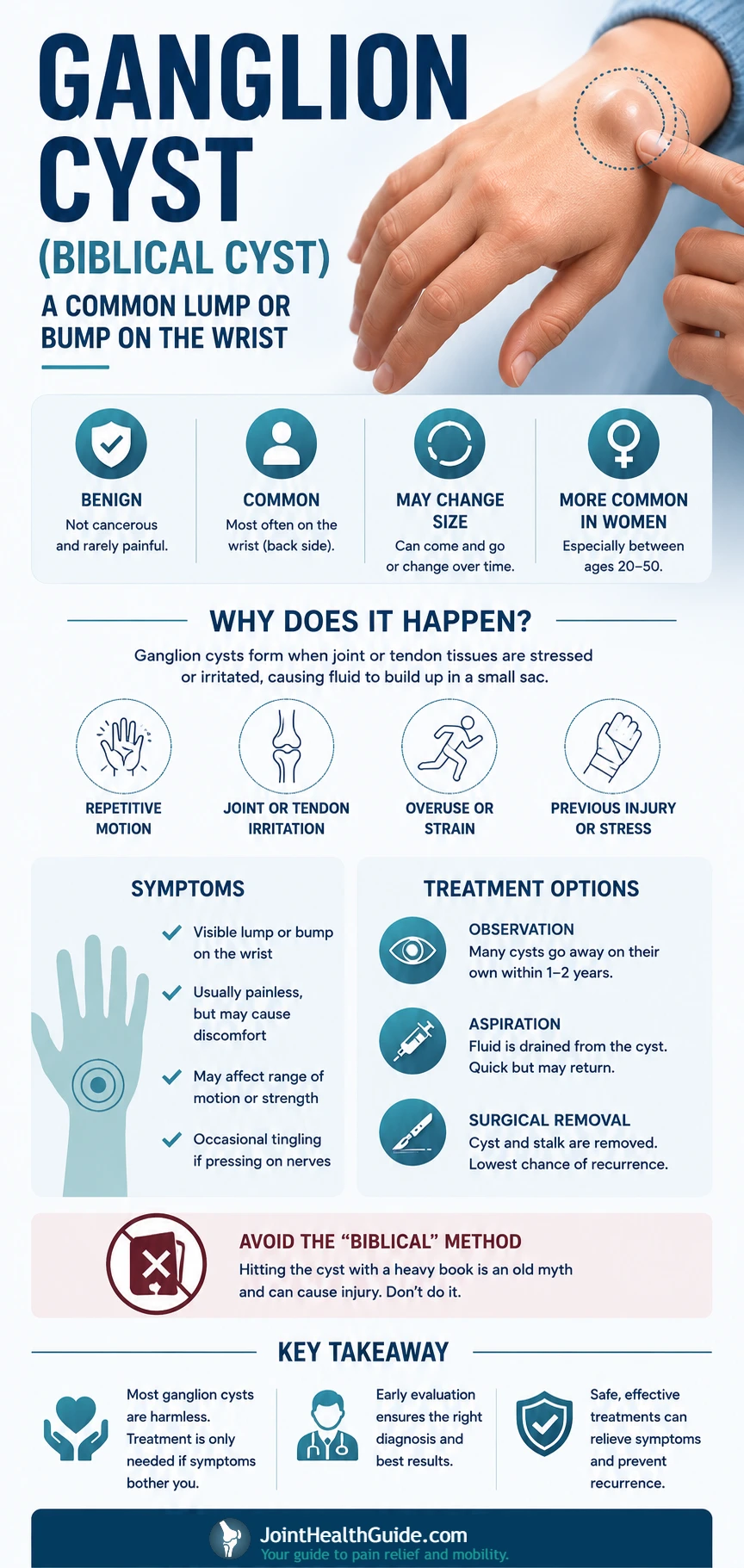
Ganglion cysts are the most common soft‑tissue masses of the wrist and hand. They are benign, often painless, and in about 50% of cases they resolve spontaneously within two years. Diagnosis is usually clinical, supported by transillumination and, when needed, ultrasound.
Treatment depends on symptoms: observation is appropriate for asymptomatic cysts, while aspiration offers short‑term relief but has a high recurrence rate. Surgical excision provides the most durable results, with recurrence in roughly 10% of cases. Importantly, ganglion cysts are not malignant and cannot transform into cancer, although they may recur or fluctuate in size over time.
Gregush RE, Habusta SF. Ganglion Cyst. StatPearls Publishing. StatPearls review: Ganglion cyst epidemiology, diagnosis, and treatment
Gude W, Morelli V. Ganglion cysts of the wrist: pathophysiology, clinical picture, and management. Current Reviews in Musculoskeletal Medicine. Open-access review: Wrist ganglion cyst pathophysiology and management strategies
Zoller SD, Benner NR, Iannuzzi NP. Ganglions in the Hand and Wrist: Advances in 2 Decades. Journal of the American Academy of Orthopaedic Surgeons. Contemporary review: Advances in diagnosis and treatment of hand and wrist ganglia
Nguyen V, Choi J, Davis KW. Imaging of Wrist Masses. Seminars in Roentgenology. Imaging review: Differential diagnosis and radiologic evaluation of wrist masses
Head L, Gencarelli JR, Allen M, Boyd KU. Wrist Ganglion Treatment: Systematic Review and Meta-Analysis. Journal of Hand Surgery. Systematic review: Outcomes of aspiration, surgical excision, and other treatment options
Dias JJ, Dhukaram V, Kumar P. The Natural History of Untreated Dorsal Wrist Ganglia and Patient Reported Outcome 6 Years after Intervention. Journal of Hand Surgery (European Volume). Long-term follow-up study: Natural history and patient-reported outcomes of dorsal wrist ganglia
Lu S, Kerluku J, Nwawka OK, Miller TT, Fufa DT. No Difference in Reintervention at 1-Year Between Ultrasound-Guided versus Blind Dorsal Carpal Ganglion Aspiration. Journal of Hand Surgery Global Online. Comparative study: Ultrasound-guided versus blind aspiration for dorsal wrist ganglion cysts