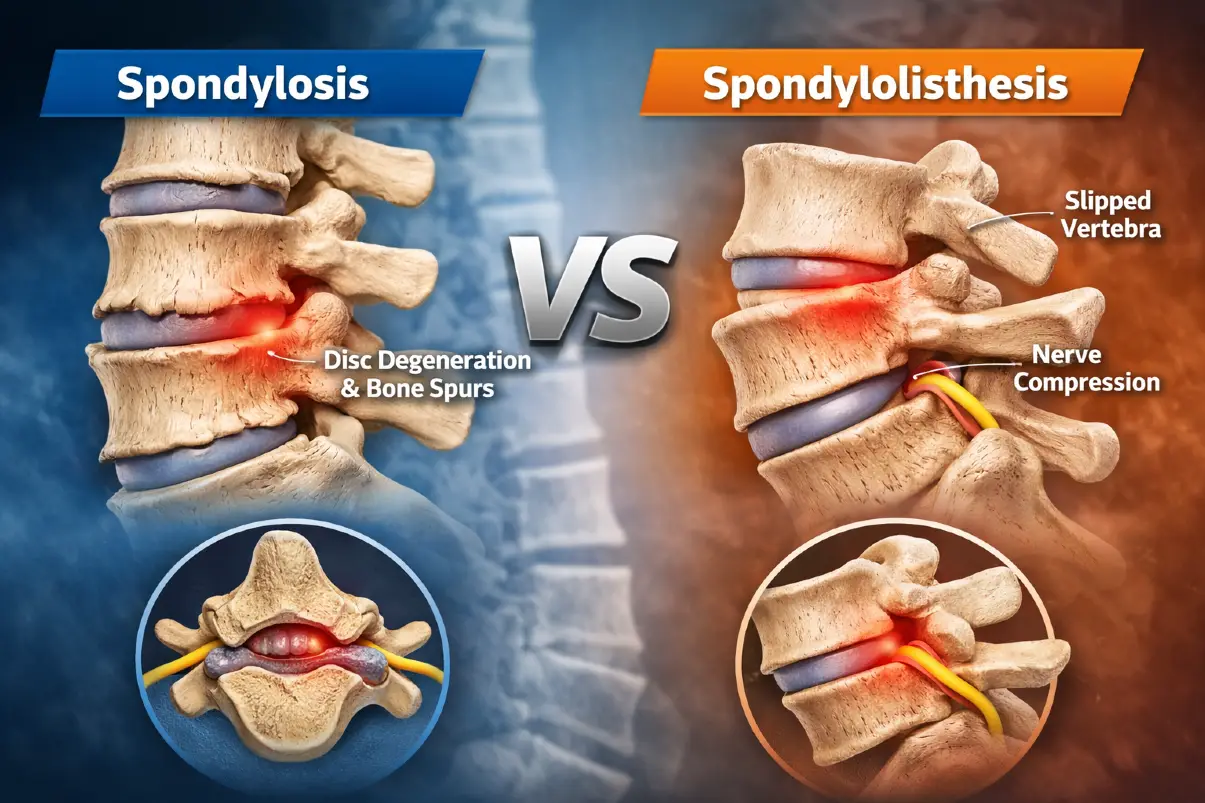
Spondylosis vs spondylolisthesis are two common spinal conditions that are often confused, but they involve very different structural changes.
Spondylosis refers to age-related degeneration of the spine, while spondylolisthesis occurs when one vertebra slips forward over another. Understanding the difference is essential for accurate diagnosis and proper treatment.
- Spondylosis is a degenerative condition caused by aging and wear and tear of the spine.
- Spondylolisthesis is a structural condition where a vertebra slips forward out of place.
- Spondylosis mainly causes stiffness and chronic pain, while spondylolisthesis more often causes nerve-related symptoms.
- Spondylolisthesis can develop as a result of degenerative changes associated with spondylosis.
- Both conditions can affect the lumbar or cervical spine, but their severity and treatment differ.
Introduction
The terms spondylosis vs spondylolisthesis are often confused, but they describe two fundamentally different spinal conditions. Spondylosis is a degenerative condition caused by age-related wear and tear, while spondylolisthesis involves the forward slipping of one vertebra over another, leading to potential spinal instability.
Although both conditions can affect the cervical or lumbar spine and may cause similar symptoms such as back pain, their underlying mechanisms, progression, and impact on spinal structure are significantly different. In some cases, degenerative changes seen in spondylosis may even contribute to the development of spondylolisthesis.
Understanding the difference between spondylolisthesis vs spondylosis is essential for identifying the cause of symptoms, recognizing nerve-related complications, and choosing the most appropriate treatment approach—especially when dealing with persistent lower back pain or possible nerve compression.
What Is Spondylosis?
Spondylosis is a degenerative condition of the spine caused by age-related wear and tear affecting the intervertebral discs, joints, and bones. As the spine ages, discs gradually lose hydration and elasticity, leading to structural changes such as bone spurs and reduced joint function.
The most common cause of spondylosis is aging, but other contributing factors include repetitive stress, previous injuries, poor posture, and genetic predisposition. Over time, these changes can reduce the space available for nerves and, in some cases, lead to nerve compression.
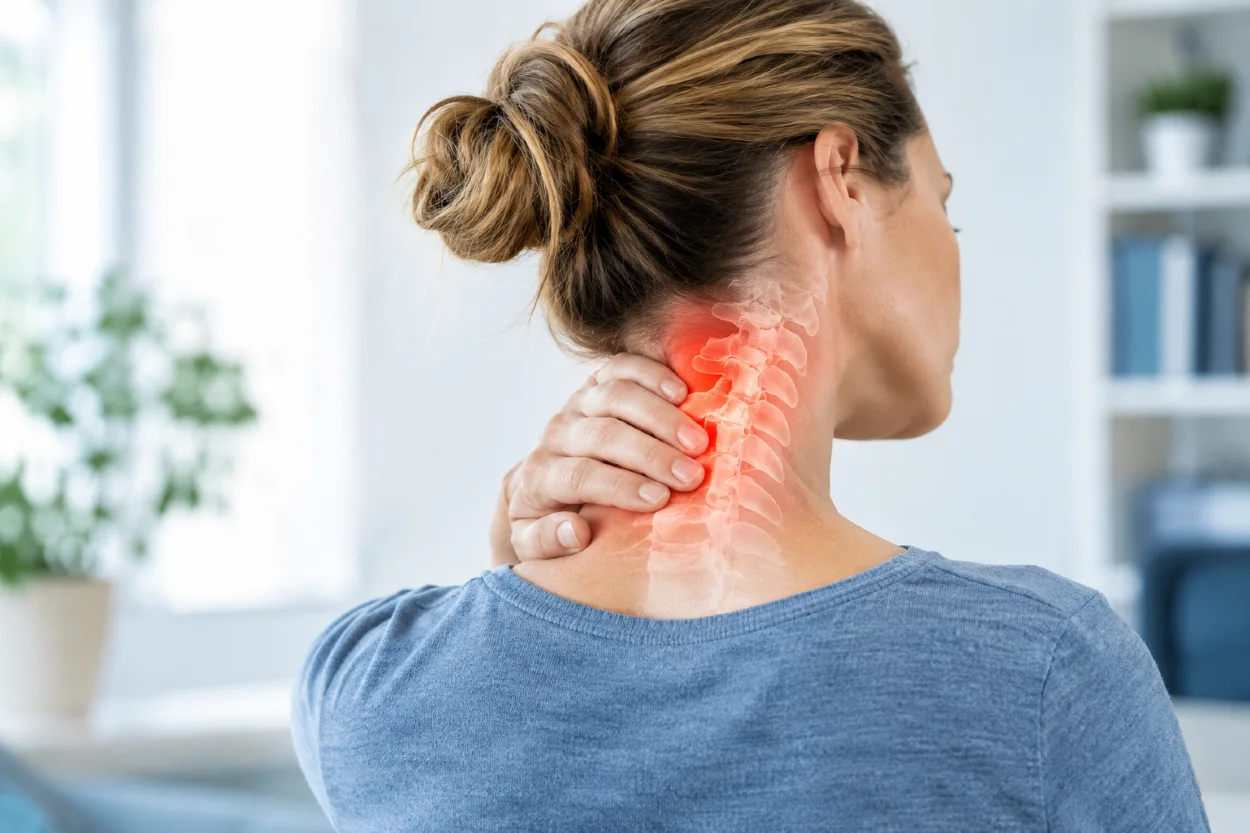
Spondylosis can affect different parts of the spine, but it most commonly occurs in the cervical spine (neck) and lumbar spine (lower back). Cervical spondylosis is especially common, affecting the majority of people over the age of 60.
Symptoms vary depending on severity and location. Many people have no symptoms, but when they do occur, they typically include:
- Neck or lower back pain
- Stiffness and reduced range of motion
- Headaches (especially in cervical spondylosis)
- Tingling, numbness, or weakness if nerves are compressed
In more advanced cases, nerve or spinal cord compression may lead to coordination problems or difficulty walking.
To learn more about this condition, read our detailed guide on spondylosis here: Spondylosis: What It Really Is, Risk Factors, Symptoms, and Treatment
What Is Spondylolisthesis?
Spondylolisthesis is a condition in which one vertebra slips forward relative to the vertebra below it, most commonly in the lower (lumbar) spine. This displacement can vary in severity and may affect spinal stability, especially when the supporting structures of the spine are weakened.
Spondylolisthesis can develop for several reasons, and it is typically classified into different types based on the underlying cause. The most common types include:
- Degenerative spondylolisthesis – caused by age-related wear and tear of discs and joints
- Isthmic spondylolisthesis – resulting from a defect or stress fracture in the pars interarticularis
- Congenital (dysplastic) – due to structural abnormalities present at birth
- Traumatic or pathologic – caused by injury or underlying disease
Symptoms can vary widely depending on the degree of vertebral slippage and whether nerves are affected. Some people may have no symptoms, while others experience:
- Lower back pain that worsens with activity or prolonged standing
- Stiffness and reduced mobility
- Radiating pain into the legs (sciatica)
- Numbness, tingling, or weakness in the lower extremities
- A feeling of instability or difficulty walking
These nerve-related symptoms occur when the slipped vertebra narrows the space for spinal nerves, leading to compression or irritation. In more severe cases, neurological deficits may develop and require medical evaluation.
For a more in-depth explanation of causes, symptoms, and treatment options, visit our full article on spondylolisthesis:
👉 https://jointhealthguide.com/spondylolisthesis
Spondylolisthesis vs Spondylosis: Detailed Comparison
Although spondylolisthesis vs spondylosis may sound similar, these conditions differ significantly in how they affect spinal structure, how they develop, and the symptoms they produce. Understanding these differences is essential for accurate diagnosis, especially when evaluating chronic back pain and potential nerve-related symptoms.
Structure of the Problem
The key difference lies in the structural changes within the spine.
Spondylosis is a degenerative condition that affects the intervertebral discs, facet joints, and vertebral bodies over time. It is primarily associated with disc degeneration, bone spur formation, and reduced spinal flexibility, without actual displacement of the vertebrae.
In contrast, spondylolisthesis is a mechanical condition characterized by vertebral slippage, where one vertebra moves forward over the one below it. This misalignment can affect spinal alignment and may lead to nerve compression in more severe cases.
Underlying Mechanism
Spondylosis develops as a result of aging and chronic mechanical stress on the spine. Over time, intervertebral discs lose hydration and height, while facet joints undergo degenerative changes. These processes can lead to spinal stiffness and the formation of osteophytes (bone spurs).
Spondylolisthesis, on the other hand, is caused by structural instability of the spine. This may result from:
- degenerative changes
- stress fractures (especially in isthmic spondylolisthesis)
- congenital abnormalities
- trauma
In many cases, degenerative changes associated with spondylosis can weaken spinal support structures and contribute to the development of spondylolisthesis.
Spinal Stability
A key distinction in spondylosis vs spondylolisthesis is spinal stability.
Spondylosis may lead to stiffness and reduced range of motion, but the spine generally remains structurally stable in terms of alignment.
Spondylolisthesis directly impacts spinal stability and alignment due to vertebral displacement. As the condition progresses, it may result in increased mechanical instability, especially during movement, lifting, or prolonged standing.
Typical Symptoms
Both conditions can cause spinal pain, but their symptom patterns differ due to their underlying mechanisms.
Spondylosis symptoms typically include:
- Chronic neck or lower back pain
- Stiffness and reduced spinal mobility
- Occasional nerve irritation in advanced stages
Spondylolisthesis symptoms are more commonly associated with nerve compression and may include:
- Lower back pain that worsens with activity
- Radiating pain into the legs (sciatica)
- Numbness, tingling, or weakness (radiculopathy)
- Difficulty standing or walking due to instability
Who Is More Affected?
Spondylosis is highly common and primarily affects older adults, as it is strongly linked to age-related degenerative changes.
Spondylolisthesis can also occur in older individuals, particularly in degenerative forms. However, it is additionally seen in younger patients, especially athletes exposed to repetitive spinal stress. Isthmic spondylolisthesis is often associated with sports such as gymnastics, football, or weightlifting.
Summary of Key Differences
In summary, when comparing spondylolisthesis vs spondylosis, the key distinction is that:
- Spondylosis is a degenerative condition involving spinal wear and tear, disc degeneration, and reduced mobility
- Spondylolisthesis is a structural condition involving vertebral slippage, spinal misalignment, and potential nerve compression
Although they can coexist and overlap—especially in degenerative cases—their underlying mechanisms, stability impact, and treatment approaches are fundamentally different.
| Feature | Spondylosis | Spondylolisthesis |
|---|---|---|
| Definition | Degenerative changes of the spine affecting discs, joints, and vertebrae | Forward slippage of one vertebra over another |
| Underlying Cause | Aging, wear and tear, disc degeneration | Degeneration, stress fracture, congenital defects, or trauma |
| Structural Change | Disc height loss, bone spurs, joint degeneration | Vertebral displacement and misalignment |
| Spinal Stability | Generally stable but stiff | Potentially unstable due to vertebral slippage |
| Common Symptoms | Pain, stiffness, reduced mobility | Back pain, leg pain (sciatica), numbness, weakness |
| Nerve Involvement | Less common, usually in advanced stages | More common due to nerve compression |
| Most Affected Group | Older adults | Older adults and young athletes (depending on type) |
| Progression | Gradual, age-related progression | May worsen over time depending on severity |
Can Spondylosis Lead to Spondylolisthesis?
Spondylosis and spondylolisthesis are closely related conditions, and in some cases, one can contribute to the development of the other. While they are not the same condition, their progression can be interconnected, especially in the context of age-related changes in the spine.
Over time, the degenerative changes seen in spondylosis—such as disc height loss, weakened ligaments, and joint degeneration—can lead to reduced spinal stability. As the spine becomes less stable, it may increase the risk of one vertebra slipping forward over another, resulting in spondylolisthesis.
This connection is most commonly seen in degenerative spondylolisthesis, where long-term wear and tear gradually affect the structures that normally keep the vertebrae aligned. In this way, what begins as spondylosis can, in some cases, progress into a more structural condition involving vertebral displacement.
Understanding the relationship between spondylosis vs spondylolisthesis is important, as early detection of degenerative changes may help prevent further progression and reduce the risk of spinal instability. Proper management, including strengthening exercises and medical monitoring, can play a key role in maintaining spinal health and function.
Diagnosis and Treatment
Proper diagnosis is essential when comparing spondylosis vs spondylolisthesis, as both conditions can present with similar symptoms but require different management approaches.
Imaging (X-ray, MRI)
Diagnosis typically begins with imaging studies. X-rays are often the first step, as they can clearly show bone alignment and, in the case of spondylolisthesis, reveal vertebral slippage.
MRI (Magnetic Resonance Imaging) provides a more detailed view of soft tissues, including intervertebral discs, nerves, and spinal cord. It is especially useful for detecting nerve compression, inflammation, and early degenerative changes associated with spondylosis.
In some cases, a combination of imaging methods is used to confirm the diagnosis and assess the severity of the condition.
Conservative Treatment
In most cases, both spondylosis and mild to moderate spondylolisthesis are treated conservatively. Treatment aims to reduce pain, improve function, and prevent further progression.
Common conservative approaches include:
- Physical therapy and targeted exercises to strengthen core and back muscles
- Pain relief medications such as NSAIDs
- Activity modification and posture correction
- Heat or cold therapy
- In some cases, bracing to provide additional spinal support
Conservative treatment is often effective, especially when symptoms are mild and there is no significant nerve compression.
When Is Surgery Needed?
Surgery is generally considered only in more severe cases or when conservative treatments fail to provide relief.
Surgical intervention may be recommended if:
- There is significant nerve compression causing persistent pain, numbness, or weakness
- Symptoms worsen despite non-surgical treatment
- There is progressive spinal instability or severe vertebral slippage (in spondylolisthesis)
- Quality of life is significantly affected
The goal of surgery is to relieve nerve pressure and stabilize the spine, often through procedures such as spinal fusion.
When to Seek Medical Help
While both spondylosis and spondylolisthesis can often be managed conservatively, it is important to seek medical attention if certain warning signs or “red flags” appear. These symptoms may indicate nerve involvement, spinal instability, or a more serious underlying condition.
Red Flag Symptoms:
- Severe or persistent back or neck pain that does not improve with rest
- Pain that radiates into the arms or legs
- Numbness, tingling, or weakness in the extremities
- Loss of coordination or difficulty walking
- Loss of bladder or bowel control (a medical emergency)
- Rapid worsening of symptoms over time
- Pain following trauma or injury
These symptoms may be associated with nerve compression or significant spinal changes, especially when comparing spondylosis vs spondylolisthesis. Early diagnosis and treatment can help prevent complications and improve long-term outcomes.
If you experience any of these symptoms, it is important to consult a healthcare professional as soon as possible for proper evaluation and management.
Frequently Asked Questions (FAQ)
Is spondylosis the same as spondylolisthesis?
No, spondylosis and spondylolisthesis are not the same condition. Spondylosis is a degenerative spine condition caused by age-related wear and tear, affecting the intervertebral discs, facet joints, and overall spinal structure.
In contrast, spondylolisthesis involves vertebral slippage, where one vertebra moves forward over another, potentially affecting spinal alignment and leading to spinal instability or nerve compression. Although both conditions can occur in the same individual, they represent fundamentally different spinal problems.
Which condition is more serious?
Neither condition is always more serious—it depends on the severity and the presence of symptoms.
Spondylosis is often a slow, degenerative process that may remain mild or even asymptomatic for many years. However, in advanced cases, it can contribute to spinal stiffness and nerve irritation.
Spondylolisthesis, on the other hand, can become more serious when it leads to nerve compression, spinal instability, or significant vertebral misalignment, which may cause symptoms such as lower back pain, sciatica, or neurological deficits.
In both cases, severe symptoms may require medical evaluation and treatment.
Can you have both at the same time?
Yes, it is possible to have both spondylosis and spondylolisthesis simultaneously.
In fact, degenerative changes associated with spondylosis—such as disc degeneration, loss of disc height, and weakening of spinal structures—can contribute to the development of degenerative spondylolisthesis.
This overlap is particularly common in older adults, where age-related spinal degeneration affects both structure and stability.
Is spondylolisthesis always painful?
No, spondylolisthesis is not always painful.
Some individuals have mild vertebral slippage without experiencing any symptoms. When symptoms do occur, they are often related to nerve compression or spinal instability and may include:
- Lower back pain
- Pain radiating into the legs (sciatica)
- Numbness, tingling, or weakness
- Difficulty with movement or standing
The severity of symptoms typically depends on the degree of slippage and whether nearby spinal nerves are affected.
Conclusion
Understanding the difference between spondylosis vs spondylolisthesis is essential for identifying the underlying cause of spinal symptoms and choosing the most appropriate treatment approach.
While both conditions can affect the spine and cause overlapping symptoms such as lower back pain and stiffness, they differ significantly in their underlying mechanisms. Spondylosis is primarily a degenerative condition involving spinal wear and tear, including disc degeneration and joint changes. In contrast, spondylolisthesis is characterized by vertebral slippage, which can affect spinal alignment and lead to spinal instability and nerve compression.
Early diagnosis and proper management play a key role in reducing pain, maintaining mobility, and preventing further progression of spinal degeneration or structural changes. If you are experiencing persistent back or neck pain, radiating symptoms, or signs of nerve involvement, it is important to seek medical evaluation for an accurate diagnosis and personalized treatment plan.
Kalichman L, Hunter DJ. Diagnosis and conservative management of degenerative lumbar spondylosis. Eur Spine J. 2008. Available from: PubMed
StatPearls. Spondylolisthesis. [Updated 2024]. Treasure Island (FL): StatPearls Publishing. Available from: NCBI
StatPearls. Spondylosis. [Updated 2024]. Treasure Island (FL): StatPearls Publishing. Available from: NCBI
North American Spine Society. Clinical Guidelines for Degenerative Lumbar Spine Conditions. Available from: Spine.org
American Academy of Orthopaedic Surgeons. Adult Spondylolisthesis. Available from: AAOS
Mayo Clinic Staff. Spondylosis – Symptoms and causes. Available from: Mayo Clinic
Mayo Clinic Staff. Spondylolisthesis – Symptoms and causes. Available from: Mayo Clinic
National Institute of Neurological Disorders and Stroke (NINDS). Low Back Pain Fact Sheet. Available from: NINDS
American Association of Neurological Surgeons (AANS). Spondylolisthesis Overview. Available from: AANS