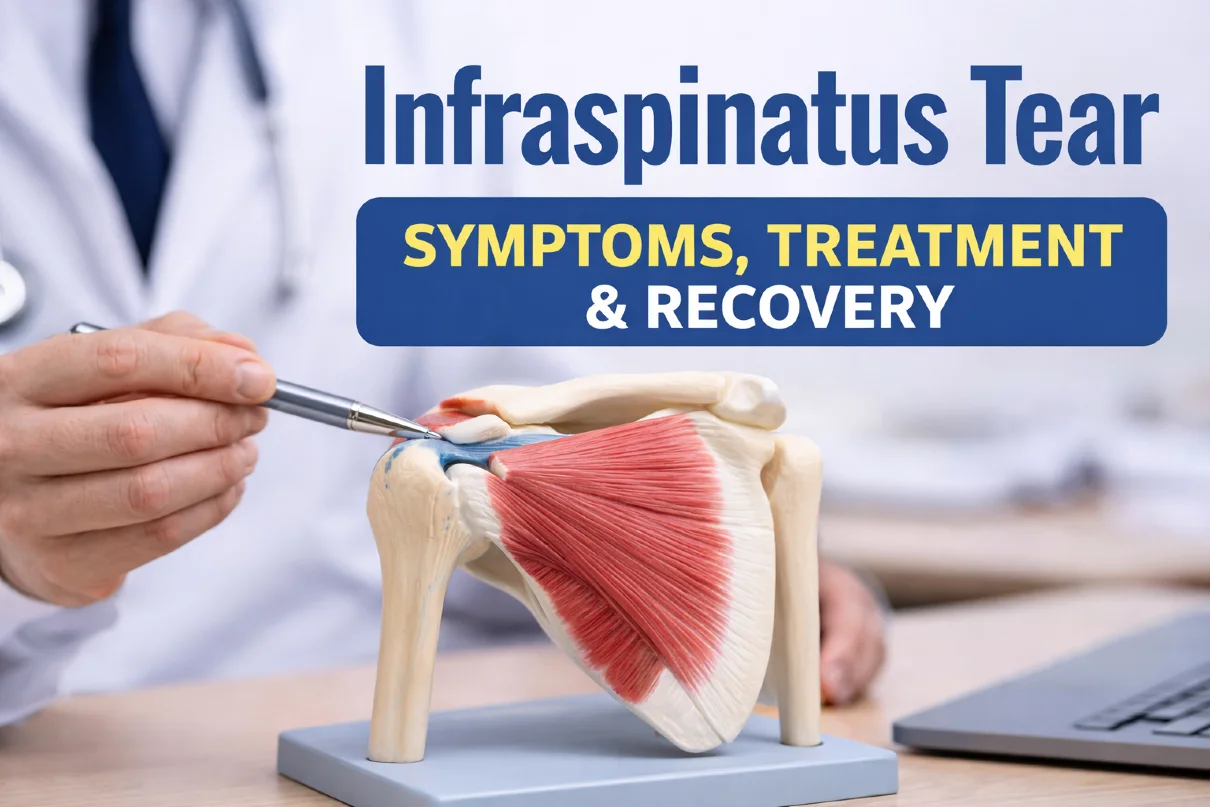
Shoulder pain is one of the most frequent musculoskeletal complaints I see in clinical practice. While many patients assume it is due to “general strain” or aging, a significant number of cases are actually related to rotator cuff injuries, including an infraspinatus tear.
This type of injury can be subtle at first—often presenting as mild discomfort or weakness—but over time it may significantly impact daily function, sleep quality, and athletic performance.
In this article, I will explain—in clear, patient-friendly language—what an infraspinatus tear is, why it occurs, how to recognize it early, and what the most effective treatment strategies are.
Key Clinical Points – Infraspinatus Tear
- Infraspinatus tear is a type of rotator cuff injury that affects shoulder stability and external rotation of the arm.
- The most common causes include repetitive overhead activity, age-related degeneration, and acute trauma such as falls or heavy lifting.
- Typical symptoms are posterior shoulder pain, weakness in external rotation, and discomfort that often worsens at night.
- Diagnosis is based on clinical examination and confirmed with imaging, with MRI being the gold standard for assessing tendon damage.
- Conservative treatment—including physical therapy, activity modification, and pain management—is effective in most partial tears.
- Surgical repair may be required in full-thickness tears or when symptoms persist despite adequate non-surgical management.
What Is the Infraspinatus Muscle?
The infraspinatus is one of four muscles that form the rotator cuff, a group responsible for stabilizing the shoulder joint during movement. It is located on the back of the shoulder blade and attaches to the upper arm bone.
Its primary role is to allow external rotation of the arm while simultaneously helping keep the shoulder joint stable during both simple and complex movements. This function becomes especially important during activities such as throwing, lifting, swimming, or any repetitive overhead motion.
Because the shoulder joint sacrifices stability for mobility, the infraspinatus—and the rotator cuff as a whole—is particularly vulnerable to injury.
What Is an Infraspinatus Tear?
An infraspinatus tear occurs when the tendon of this muscle becomes damaged, either partially or completely. In clinical practice, these tears are often part of a broader rotator cuff pathology, although isolated tears can also occur.
Some tears develop gradually over time due to chronic overload, while others happen suddenly as a result of trauma. The severity of the tear plays a major role in both symptoms and treatment decisions.
Common Causes of Infraspinatus Tears
In most patients, the cause is not a single event but rather a combination of factors that progressively weaken the tendon.
Repetitive overhead activity is one of the leading contributors. Athletes such as tennis players, swimmers, and baseball players frequently place high mechanical stress on the rotator cuff. Similarly, individuals with physically demanding jobs or repetitive arm movements are at increased risk.
Age-related degeneration is another key factor. As we get older, tendon tissue naturally loses elasticity and blood supply decreases. This makes the rotator cuff more susceptible to injury—even during normal daily activities.
Acute injuries can also lead to an infraspinatus tear. Falls, sudden lifting of heavy objects, or shoulder dislocations may cause immediate tendon damage.
Finally, poor posture and altered shoulder mechanics—particularly common in individuals who spend long hours at a desk—can increase strain on the rotator cuff and contribute to long-term degeneration.
Symptoms of an Infraspinatus Tear
The symptoms can vary depending on the size and type of the tear, but there are several patterns I commonly observe in patients.
Shoulder pain is usually the first sign. It is typically located in the back or outer part of the shoulder and may radiate down the arm. Many patients report that the pain becomes more noticeable at night (night pain), especially when lying on the affected side.
Weakness is another important symptom, particularly during movements that involve external rotation. Patients often describe difficulty with activities such as reaching backward, lifting objects, or performing sports movements.
Range of motion may gradually become limited, either due to pain or mechanical restriction. In some cases, patients also report a sensation of catching or clicking within the shoulder.
One important clinical point: not all tears cause severe pain. Some patients primarily notice weakness or reduced performance rather than discomfort.
Clinical Insight
One important clinical point is that not all infraspinatus tears cause severe pain. Some patients primarily notice weakness or reduced performance rather than discomfort.
How Is an Infraspinatus Tear Diagnosed?
A proper diagnosis always begins with a detailed medical history and physical examination. Understanding how the symptoms started and what aggravates them provides valuable clues.
During the physical exam, specific tests are used to assess rotator cuff strength and function, particularly external rotation. These findings often guide the next step in evaluation.
Imaging plays a key role in confirming the diagnosis. Ultrasound can be a useful and accessible first-line tool, especially in experienced hands. However, MRI remains the gold standard, as it provides detailed visualization of soft tissues and helps determine the size and extent of the tear.
Treatment Options for Infraspinatus Tear
Treatment depends on several factors, including the severity of the tear, the patient’s age, activity level, and functional goals.
Non-Surgical Treatment (First-Line Approach)
In the majority of cases, especially with partial tears, conservative treatment is highly effective.
The first step is usually activity modification. Reducing or temporarily avoiding movements that aggravate symptoms—particularly overhead activities—allows the tendon to recover.
Physical therapy is the cornerstone of treatment. A well-structured rehabilitation program focuses on improving shoulder mechanics, strengthening surrounding muscles, and restoring mobility. In my experience, patients who adhere to a guided physiotherapy program achieve significantly better outcomes.
Pain management may include short-term use of anti-inflammatory medications, application of ice, and in selected cases, corticosteroid injections. However, injections should be used judiciously and not as a long-term solution.
Equally important—but often overlooked—is posture correction. Addressing forward shoulder posture and scapular dysfunction can substantially reduce strain on the rotator cuff.
When Is Surgery Necessary?
Surgery is not the first option, but it becomes relevant in specific situations.
Patients who do not improve after several months of structured conservative treatment may benefit from surgical evaluation. Full-thickness tears, especially in active individuals, are also more likely to require repair.
Clinical Insight
Significant weakness, loss of function, or high athletic demands are important factors that may influence the decision toward surgical treatment.
Surgical Treatment Options
The most common approach today is arthroscopic repair, a minimally invasive procedure in which the torn tendon is reattached to the bone. This technique allows for smaller incisions, less postoperative pain, and faster initial recovery.
In more complex cases, open surgical repair may still be necessary, although this is less common.
Recovery and Rehabilitation
Recovery timelines vary depending on the severity of the tear and the chosen treatment approach.
With non-surgical management, improvement is typically seen within 6 to 12 weeks, although full recovery may take longer depending on individual factors.
After surgery, rehabilitation is essential and follows a structured, phased approach. Initial immobilization is followed by gradual restoration of mobility and strength. Full recovery often takes between four to six months, and sometimes longer in high-demand individuals.
Can an Infraspinatus Tear Heal on Its Own?
This is a common question in clinical practice.
Partial tears can often improve significantly with conservative treatment, especially when diagnosed early and managed appropriately. However, full-thickness tears generally do not heal completely on their own, although symptoms can sometimes be managed without surgery.
The key is not just structural healing, but functional recovery.
How to Prevent Infraspinatus Injuries
Prevention is particularly important for individuals at higher risk.
Maintaining shoulder strength and flexibility plays a crucial role in protecting the rotator cuff. Regular, targeted exercises can help improve stability and reduce overload.
Proper warm-up before physical activity, gradual progression in training intensity, and avoiding repetitive strain are all essential strategies.
In addition, addressing posture—especially in people who spend long hours sitting—can significantly reduce long-term shoulder stress.
When Should You See a Doctor?
Many patients delay evaluation, assuming the pain will resolve on its own. However, early assessment can prevent progression.
You should seek medical advice if:
- pain persists for several weeks
- shoulder weakness becomes noticeable
- sleep is disrupted due to pain
- range of motion is limited
Early diagnosis often leads to simpler and more effective treatment.
FAQ: Infraspinatus Tear
Is an infraspinatus tear the same as a rotator cuff tear?
Not exactly. The infraspinatus is one of the rotator cuff muscles, so its tear is a type of rotator cuff injury.
How long does it take to recover?
Recovery can range from several weeks (conservative treatment) to several months after surgery, depending on severity.
Can exercise make it worse?
Yes—improper or excessive exercise can aggravate the condition. Guided physical therapy is strongly recommended.
Is surgery always necessary?
No. Most partial tears respond well to non-surgical treatment.
Final Thoughts
An infraspinatus tear is a common but frequently under-recognized source of shoulder pain. The good news is that, with early diagnosis and appropriate management, most patients achieve excellent functional recovery.
From a clinical perspective, the most important message is this: persistent shoulder pain should not be ignored. Addressing the problem early allows for simpler treatment and better long-term outcomes.
Nakajima T, et al. Rotator cuff tears: epidemiology, pathophysiology, and natural history. J Shoulder Elbow Surg. 2022. doi:10.1016/j.jse.2021.09.013
Teunis T, et al. Treatment options for rotator cuff tears. Bone Joint J. 2020. doi:10.1302/0301-620X.102B12.BJJ-2020-0673.R1
American Academy of Orthopaedic Surgeons (AAOS). Rotator Cuff Tears. View source
Nho SJ, et al. Biomechanics and management of rotator cuff injuries. Clin Sports Med. 2021.
StatPearls Publishing. Rotator Cuff Injury. NCBI Bookshelf. View source
Lewis JS. Rotator cuff related shoulder pain: Assessment, management and uncertainties. Man Ther. 2016.
European Society for Shoulder and Elbow Surgery (SECEC). Rotator cuff tear guidelines. View source
Millett PJ, et al. Management of rotator cuff tears in active patients. J Am Acad Orthop Surg. 2019.
BMJ Best Practice. Rotator cuff disorders. View source